
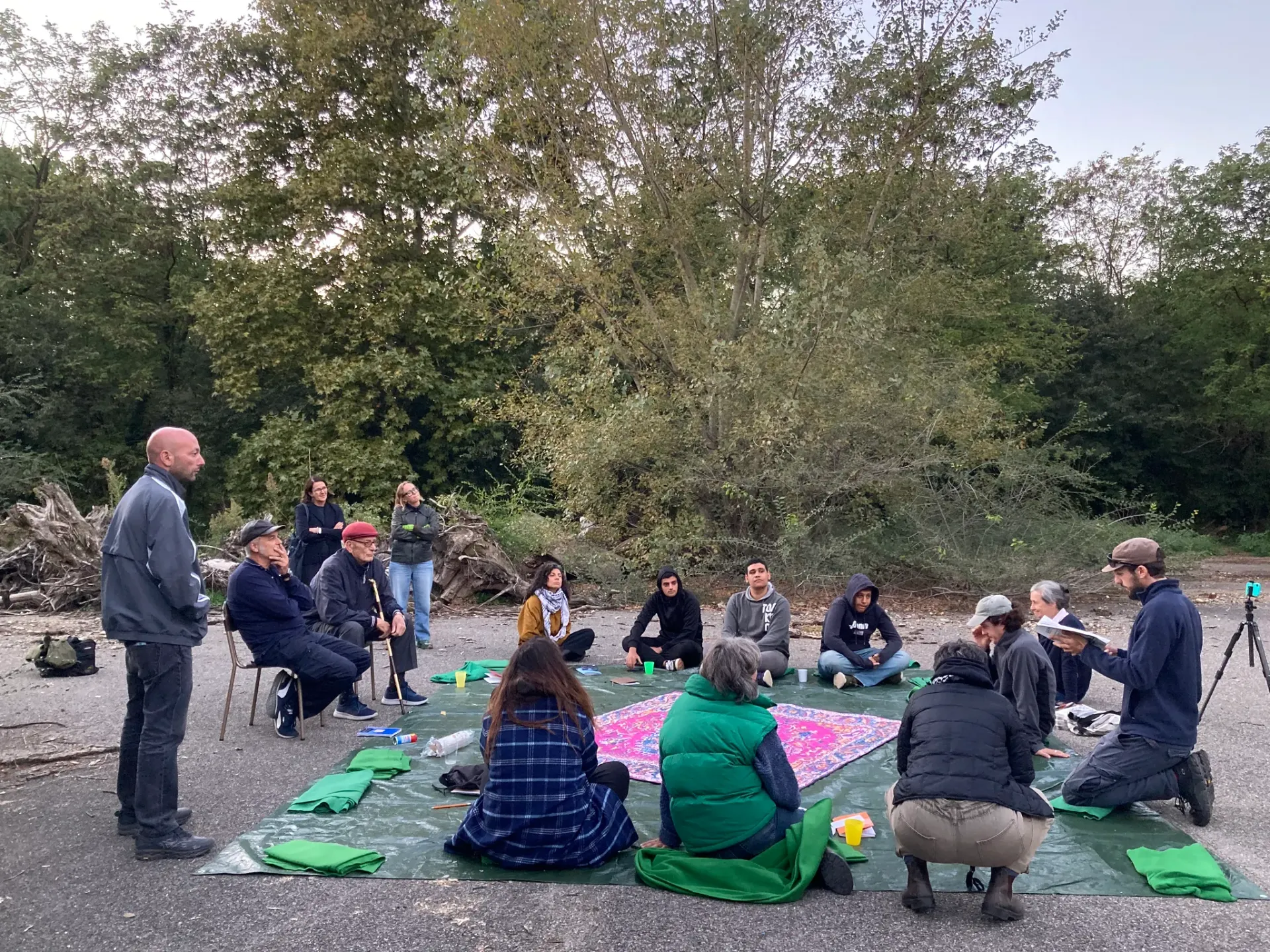
The future of the Goccia – a thirty-three-hectare area, eighteen of which are covered by a spontaneous forest, located at the heart of one of the most urbanised and densely populated regions in Europe, and just seven kilometres from Milan’s Duomo – concerns an enormous number of people, many of whom are scarcely aware of the area’s very existence.
Before taking action, before deciding how to act, it therefore becomes essential to take time to explore and define the expectations and desires of those who live around the Goccia. As part of a broader ethnographic research process, the workers’ cooperative Kilowatt – one of the many organisations involved in the Goccia Observatory – posed a series of wide-ranging questions to local residents and organisations. «From these interviews, a strong need emerged to involve younger generations in this process» from Cecilia Colombo, project manager at Kilowatt, explains. «First of all because today’s young people will be the ones who use and inhabit this place the most in the future. And secondly because adolescents are the group that, in contemporary cities, has the fewest opportunities for exploration, research and discovery outside the formal education system.»
The journey was conceived by performance artist Caterina Moroni, whose practice sits at the intersection of participatory approaches, non-conventional spaces and community engagement.
Unfortunately, I was not able to meet her on site but only via video call. I can therefore only imagine – through photographic documentation and her words – this group of adolescents (around ten young people aged between thirteen and twenty-two, some of whom attend the youth centre Il Poliedro in Villapizzone) as the gates of the Goccia were opened to them: an otherworldly and contradictory place, unlike anything they had ever experienced in the city, and yet an integral part of the very city they inhabit.

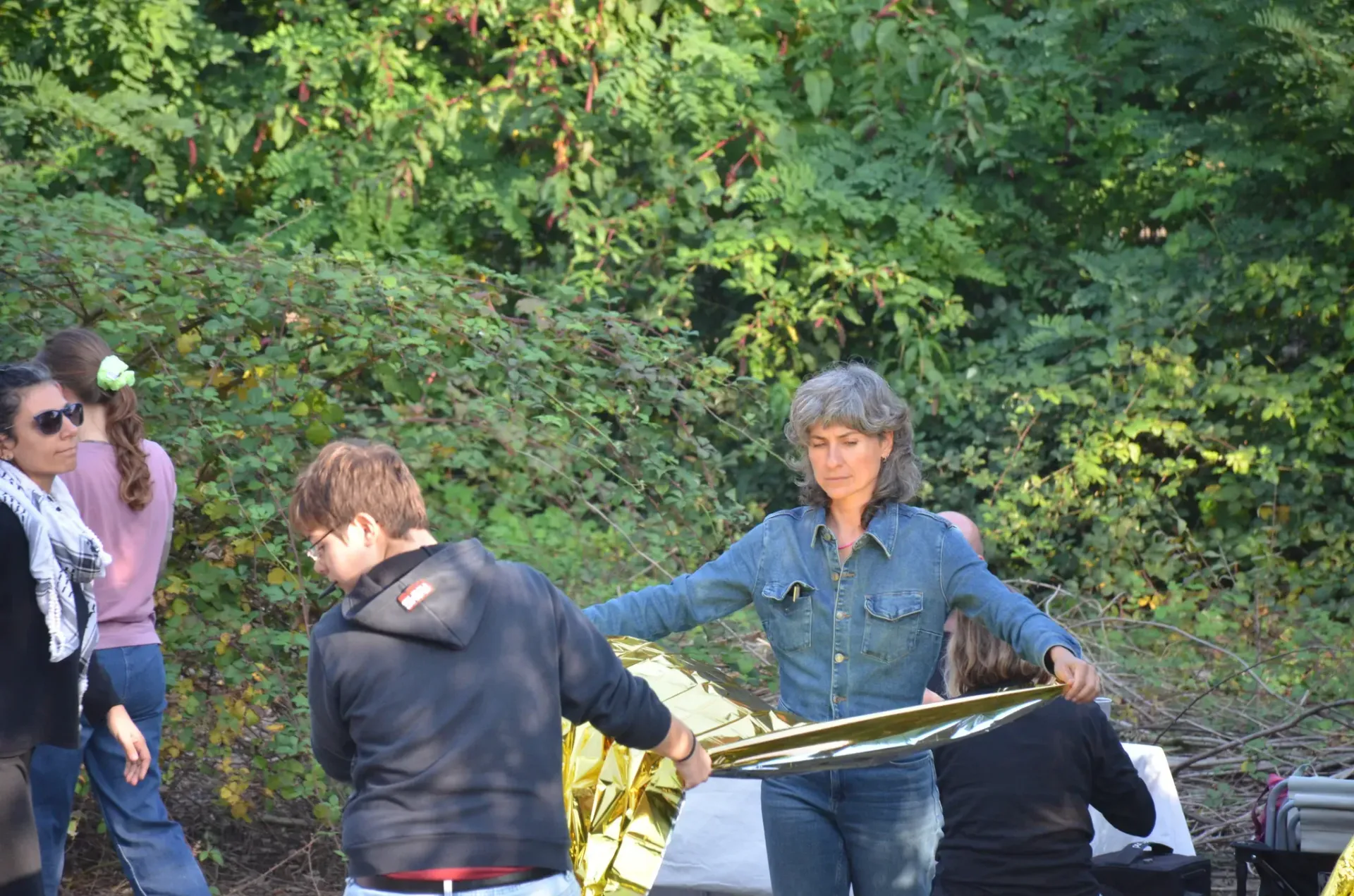
Hello Caterina. First of all, I was wondering how you, as someone who is not from Milan, came to be involved with the Goccia.
I was contacted by Kilowatt because a few years ago they had seen one of my performances in Modena. It involved a group of children and focused on climate change and on survival in this complex world. So when they decided to bring a group of adolescents into the Goccia, they thought of my work.
What was your initial idea?
I wanted to involve the young people as explorers of the sensible – to let them enter the Goccia in order to perceive the space, to feel it. To enter without answers, simply to observe, rather than to already know or label. Almost all the activities were then conceived together, agreeing on what we would do. It was a true working group. The beauty of this kind of project is that once it begins, it is impossible to keep developments under control. I was not interested in proposing a workshop for young people, but in sharing an experience with them, because for me relationships are created through doing things together.
Let’s start from the name you gave to the residency: Come gocce.
It was an intuition I had straight away, a connection I made with a sentence by Lorenzo Orsetti, known as Comandante Orso [the Florentine antifascist who died in his early thirties while fighting alongside the Kurdish YPG militia in Syria]: «Every storm begins with a single drop». Each of us on our own is a small thing, but carries great power: the power to generate collective action.
On the first day, we gave the young people a small notebook, almost like a passport to enter the space – something halfway between a private diary and an explorer’s notebook – and on the first page we wrote «every storm begins with a single drop». From that moment on, we kept this motto in mind and worked together on the idea of the storm, understood as the possible change that we can generate collectively.
We treated the forest of the Goccia as a symbol, as a metaphor for something to be defended, something we do not want to see altered.
And in practical terms, what did this exploration involve?
Every day we crossed the threshold of the Goccia holding a silent question, and then, through a ritual gesture, we let our drop fall to the ground. The idea was to enter with open hearts and minds, trying to read the signs coming from the outside.
One of the first activities was the group pact – a foundational moment in the creation of any temporary community. It was a real agreement, designed and signed by everyone, which set out the principles of being together. These ranged from respect to patience to honesty, and we all had to agree on every aspect.
Then, still on the first day, we had a picnic, with blankets and everything else, to begin settling into the place. And a long silent exploration – and I stress this adjective, silent – because silence with a group of young people of that age was quite surprising. It meant they were truly engaged.
After that, they met a series of people who came to visit us: a botanist, an architect, an elderly man from the neighbourhood who had many stories to tell. These encounters often took place through slightly gamified dynamics, in order to keep the young people’s level of attention high.
On the final day, some people came to visit us from outside, and together we got lost in the forest with them.
These activities also led to two moments that struck me as particularly significant, because they were not confined to the time and place in which you were working, but were instead projected outwards. I am referring to the letters the young people wrote and sent to a number of public figures, and to the so-called «time capsules». How did these come about, and what are they?
On the first day, I asked the young people to choose an element within the Goccia – any element at all. Among those chosen were a puddle, a lamppost, a root, a brick wall. They then spent time with their element, «befriended» it, listened to it, took a selfie with it. They allowed themselves to be permeated by the element, until in the end they were able to become a channel for its words.
On the final day, I asked them to go back to their element and remain there until they felt they could listen to it, and then write its words down. I gave them an opening line: «I am… and I am writing to tell you that…», and explained that their texts would become letters to be sent to a number of figures who, in different ways, have the power to act on the future of the Goccia: the Politecnico, the Municipality, the Observatory, nearby schools. They could write whatever they wished; the only rule was that the sentences had to be dictated by the element itself.
So the letters did not contain specific demands?
They were mainly descriptive texts, even light in tone, if you like. I remember a lamppost describing what it used to see and what it sees now. Or a root talking about the effort it makes to grow through concrete. One person chose a building as their element and imagined it as a place of production in the past, filled with machinery, explaining how wonderful it would be if it were still functioning today.
My idea was to activate a poetic device that could also become political, because the letters were sent to those who can decide or influence the fate of the Goccia. They were sent exactly as they had been written, without any edits.
What I found most interesting is that the only thing the young people were really asking for was attention. A subtle, sensitive kind of attention. They were asking people to stop and listen more carefully – to listen even to the words of those who usually have no voice, namely adolescents, and even to the words of the elements that surround us. Sometimes it is not necessary to do something; it is enough to stop and look more closely.
I am very interested in this last idea you mentioned – that in order to act well, one must first stop and listen. How did the young people respond to these slow days, spent in isolation? It seems almost the opposite of the urban context they live in.
They were not used to it, because their lives move very fast, shaped by constant scrolling. But this is not only true for them; it is true for all of us. That is why taking all the time needed to listen to an element, to practise such a subtle and sensitive form of attention, was very important to me – because it is something we rarely have the luxury of experiencing.
When notifications from the outside world arrived on our phones – notifications we could not entirely avoid, even though we tried to keep phones hidden and unused – we had set ourselves a rule: we would stop and look up at the sky for a moment. We chose not to become impatient with intrusions from the outside world, but instead to treat them as an opportunity to gaze at the sky, as people once did. It was also a way of giving ourselves time to look at something we no longer really observe.
And the letters were actually sent.
On the final day we set up a sort of post office: we put the letters into envelopes together and wrote the addresses. You have to consider that these young people had never received or sent a letter before. We wanted to use a medium that is itself disappearing, as an analogy for the fact that the Goccia, too, could disappear.
On this point, there is a tender scene I like to recall: when it came time to apply the stamps, one of the girls thought it was just a sticker and used it to seal the envelope, because she had no idea that a stamp was needed to send a letter.
And what about the time capsules? Looking at the photographs, they almost resemble goldfish bowls, the kind sometimes seen in the comics of our generation – I don’t know if that’s still the case.
To arrive at the idea of the time capsules, I started from the assumption that it was necessary to use the power of ritual in order to better understand that place – to «feel» it rather than «understand» it, because «understanding» implies rationality.
We asked the young people to imagine themselves ten years from now – which seems like a long time to us, but is not that long in relation to the Goccia and the time needed for its regeneration – and to write a note to their future selves. A simple message, an encouragement. Then we asked them to write another message for the Goccia itself, addressing what the Goccia would be like in ten years’ time.
They then placed the two notes inside the bowls, these time capsules, together with a small object found within the area, the selfies they had taken with their chosen element, and anything else they wished. The idea is that it is not only us who protect the forest of the Goccia, but that there can be a mutual exchange – that perhaps it is the forest of the Goccia that protects us, that helps us.
On the final day, together with the people who came to visit us, we went to place the time capsules among the roots of a tree. I like to think that this activity could be expanded, that the Goccia could become a guardian of people’s desires and memories – those of the neighbourhood, or of the city. That in the future anyone might go there to leave their own capsule, like a slightly paradoxical museum of dreams.
I have a question, as someone who lives in the area. For many of us, the Goccia is a very peculiar place: it is enormous but unreachable; you know it is there, but you never really get close to it. It exists and yet it doesn’t. What was the young people’s reaction once they entered it?
It is important to keep in mind that in their everyday lives their contact with nature, with greenery, is extremely limited, and that the Goccia is a complex place – very honest, but not at all comfortable or reassuring – made up of strong contrasts. When they went to choose their element, I imagined they would select something natural, but most of them opted for ruins, or in any case for something left behind by humans. Perhaps this was also, in some way, a comforting choice for them.
Similarly, when we asked them to look for «totem places», almost all of them chose spaces where there was concrete. By contrast, on the final day, when we took visitors on a walk, we deliberately got lost in nature. One image has stayed with me: a boy who on the first day did not even want to sit on the ground during the picnic, and who, before leaving on the last day, was rolling around in the grass.
So you saw an evolution.
Yes, I think I can say it was a journey of transformation. First of all because we did not enter with answers, so everything that happened was welcomed. But there was also a great transformation within the group itself. By the end of the journey I saw them touching each other, physically moving closer, exchanging knowing looks. At the beginning, by contrast, the situation was very stiff; they were somewhat uncomfortable, perhaps also because of the unusual nature of the proposal and of the place.
We are still in touch through the WhatsApp group we created to stay connected while we were in the Goccia.
One last question. Everyone I speak to who has had the opportunity to access the Goccia has had different impressions, but all agree that it is an extremely distinctive place, full of contradictions and very stimulating. What was your first impression?
Because of my work, I am used to non-conventional places; I am passionate about and experienced in getting lost. But I agree – I too think the Goccia is a very particular place. I believe it embodies the idea of a «lucid dream». I found it not at all comforting, and therefore interesting, made up of strong contrasts, exactly like us as human beings.
In fact, I had the impression that by entering that place one can recognise oneself, that it is a bit like coming home. That the Goccia is made of what we are made of: past, present and future, but also residues, tension, desire, cruelty – and above all that which makes us most human: inconsistency.
Michele Turazzi. Michele Turazzi lives in Milan and works in publishing. He has published the novel Prima della rivolta (Nottetempo 2023, winner of the Demetra Prize for Environmental Literature 2024) and the narrative reportage Milano di carta (Il Palindromo 2018).