
A neighbourhood, a place, is also, and perhaps above all, the sum of the images that have told its story. Bovisa has long been associated with a marginal position: a geographic and symbolic periphery, a space at the city’s edge. Before it even became a neighbourhood, it was part of the Corpi Santi, the municipality that encircled Milan and hosted what had to remain outside the walls, including burial grounds. Cascina Bovisa, from which the area takes its name, was incorporated into the City of Milan in 1873, marking the start of a new phase.
From farmsteads and rural oratories, Bovisa turned into an industrial territory, made of workshops, factories, and infrastructure. The station and the railway tracks fuelled the area’s industrial growth and radically reshaped the landscape. It is within these transformations, which we often remember more through images than through official accounts, that the neighbourhood finds a decisive part of its identity.
Factories, smokestacks, large housing blocks. The outskirts wrapped in the same fog that seems to cling to those old black-and-white photographs. Telling Bovisa’s visual history in a complete and definitive way is impossible: the weave of images and narratives that has passed through it is too rich, too scattered. Finding a title is just as hard. So I took inspiration from a small treasure I keep at home: Vocabolarietto figurato, a 1950s handbook for teachers and students, where words, arranged alphabetically, are not paired with cold definitions, but with short stories and illustrations.
The route proposed here moves by leaps and close-ups, relying on single images, figures, and fragments to evoke places, presences, atmospheres. It is a sideways gaze, starting from the particular and letting the general come into view. It is a tribute to the places, the people, and the events that have shaped and narrated Bovisa, each in their own way.
Let’s begin.
DEADTH ANGELS
Many of you will remember the melancholic atmosphere of a Berlin still wounded and split in two, watched over by angels in long coats in Wim Wenders’ Wings of Desire (1987). In those same years, angelic figures also haunted another city, at least in the mind of one artist: John Hejduk, a US architect of Czech origin.
In 1987, the Triennale di Milano hosted a peculiar initiative, Le città immaginate (Imagined Cities). Italian and international architects were asked to reimagine nine Italian cities. For Milan, the selected areas included Bovisa, then marked by the construction works around the station and the vast disused gasometer site.
Hejduk produced sixty pen-and-ink drawings (viewable here), later collected in a book of the same name. On the cover stands the “Chapel”, a kind of transfigured gasometer, from whose dome unsettling metal spikes rise up. Hejduk’s Bovisa is a black-and-white place, silent and apocalyptic, not far from Wenders’ Berlin. Industrial landscapes alternate with dystopian inventions and machinery, while a suspended, unreal atmosphere seems to dominate everything.
The angels do not listen to human thoughts, as they do in Wenders’ film. Their nature remains ambiguous: benevolent presences, or threatening ones? There is no way to know. A horse-drawn hearse carries dead angels, but perhaps it is precisely through their sacrifice that a possible redemption can take place, a prelude to the site’s rebirth.

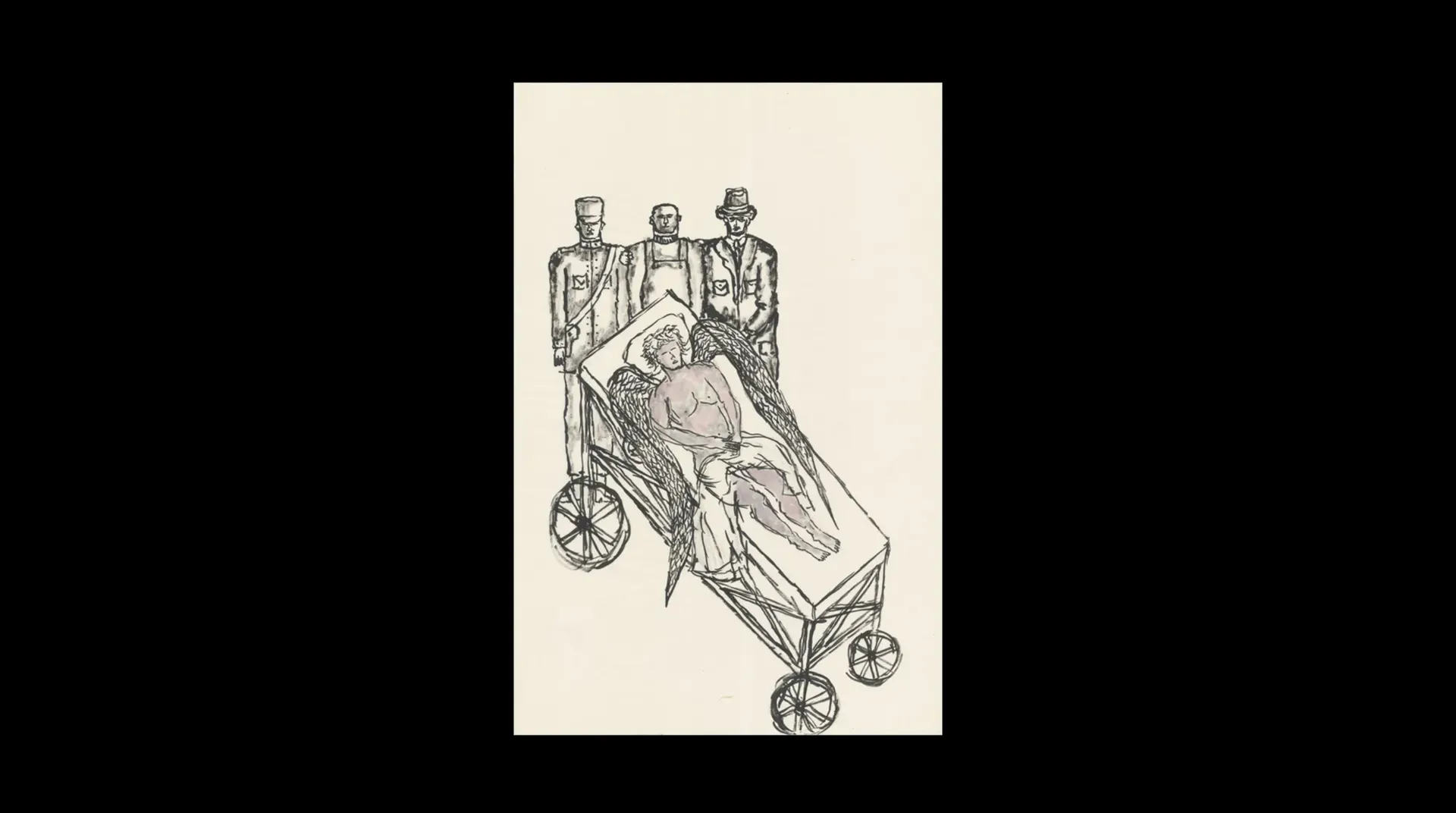
From: "Bovisa: A work by John Hejduk"
HEREMIT
Mary of Egypt, Simeon Stylites, Onuphrius the Anchorite… We often assume a hermit must have an exotic, lofty name, and live in remote, barren places — on mountain peaks, or in Greece among the rock pillars of Meteora. Bovisa’s hermit, instead, was simply called Giovanni Moretti: a thoroughly Lombard surname.
The fourth of eleven children and the son of farmers, Giovanni spent the second half of his life in a hut in the middle of the fields, right where, a few years later, the FN Bovisa rail yard would rise.
Before choosing the hermit’s life, he had worked the land and, together with his wife, ran a tavern and a small food shop. He was widowed at 37, with a son to raise. It was around that time that he began to reject the idea of profit and to be content with very little, even lowering the tavern’s prices to cost.
Then, one day, he decided to put on a habit and hand the tavern over to his brother. He entrusted his son to relatives, abandoned secular life, and went to live barefoot in the fields. He helped the poor and devoted himself solely to good works. He was never a saint, nor even blessed — but if we were to choose a patron saint for Bovisa, it would be fitting to think of Giovanni Moretti.
A Corriere della Sera article from 1949 remembered him like this:
“He was a figure who drew much attention from 1860 onwards for the strange and ascetic form of his life, and for his proclaimed virtues as a healer. The hermit of Villapizzone. Who was he? They also called him ‘Giovanin Romita’. […] Wearing a sort of Franciscan habit, he tied a cord around his waist and divided his time between prayer and work in the fields, helping the poorest farmers. Little by little, ever more visitors began to arrive: some asked for advice, others for prayers to be healed of their ailments. They found him in his little hut, amid countless small altars assembled one after another, before which he lit rows of small candles and oil lamps…”

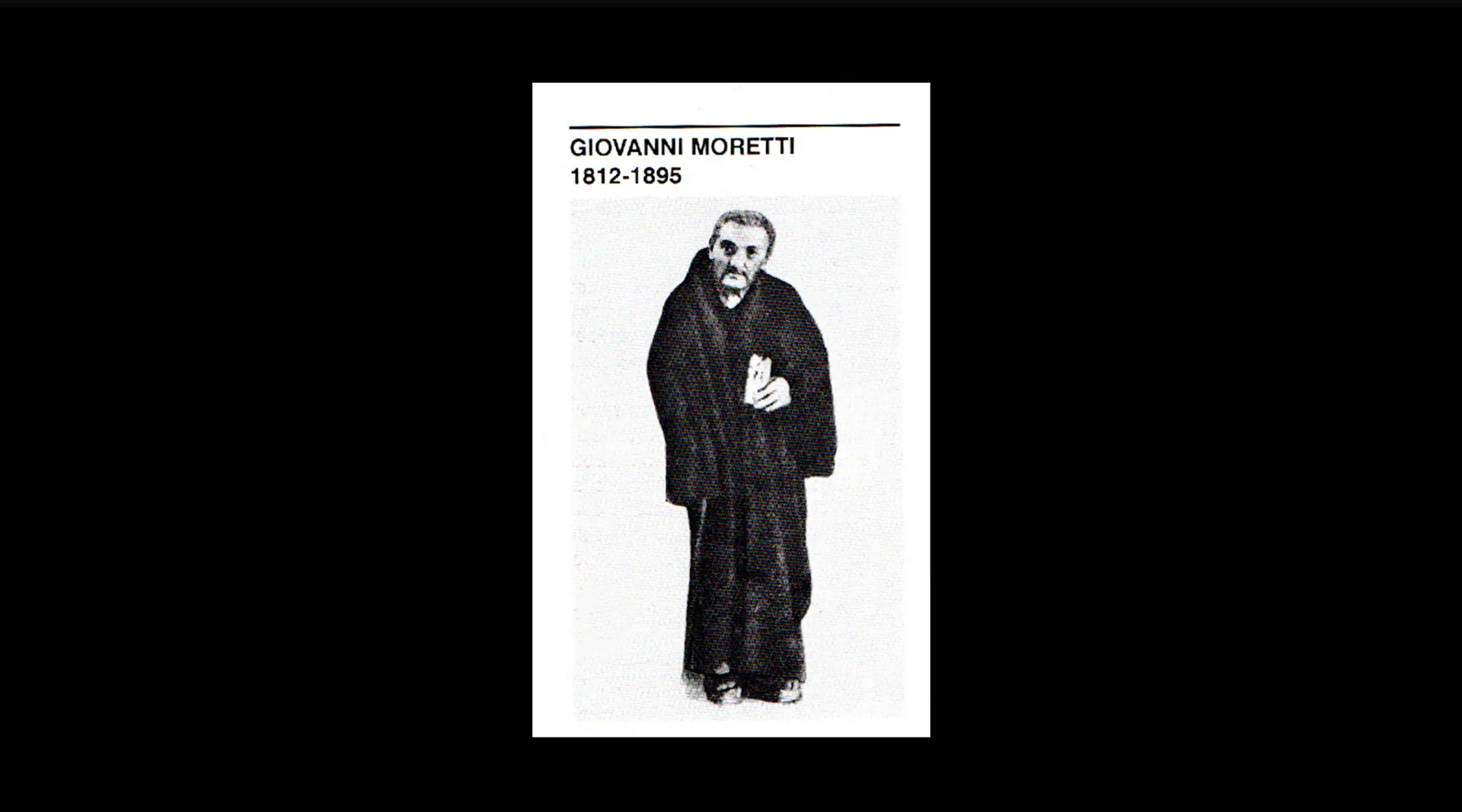
The hermit of Villapizzone, Giovanni Moretti
GASOMETER
“Just beyond the factories, the chimneys, and Bovisa’s gasometers, the Nord trains went back and forth — indifferent and fast”: this is how the writer Giovanni Testori describes Bovisa in his novel Il Fabbricone (1961). The gasometers, symbols of the neighbourhood, had been there for a long time. As early as 1905, the colossal structures of the Gasworks were grinding coal to produce gas for heating the city.
Mario Sironi, a Sardinian-born painter who lived in Milan, depicted them in a typical slice of the northern industrial outskirts: factory walls, grey and brown tones, huge tenement blocks, and almost no human presence. In the 1920s he began his cycle of Urban Landscapes and City Outskirts, trying to capture the solitude of the new industrial civilisation. “Milan is ugly but solid,” he wrote to a friend in 1919 — and it was precisely that solidity that seemed to fascinate him.
The well-known painting Il gasometro dates to 1943 and closely resembles the gasometer on Via Olbia in Bovisa. Whether it is exactly that one, we cannot know: Sironi painted in the studio, never from life. Architect Aldo Rossi would later dwell, in a text, on Sironi’s technical and analytical eye (Sironi had enrolled in Engineering in Rome, without ever completing his studies):
“Engineer Sironi noticed the gasometers as no painter could have done; in Sironi’s gasometers the rust of the iron seems to seep down from the clouds, the city is wrapped in a white-rust sky as if from plague or smog or new, terrible illnesses that corrode iron, stone, plaster… But what city has ever been more beautiful?”

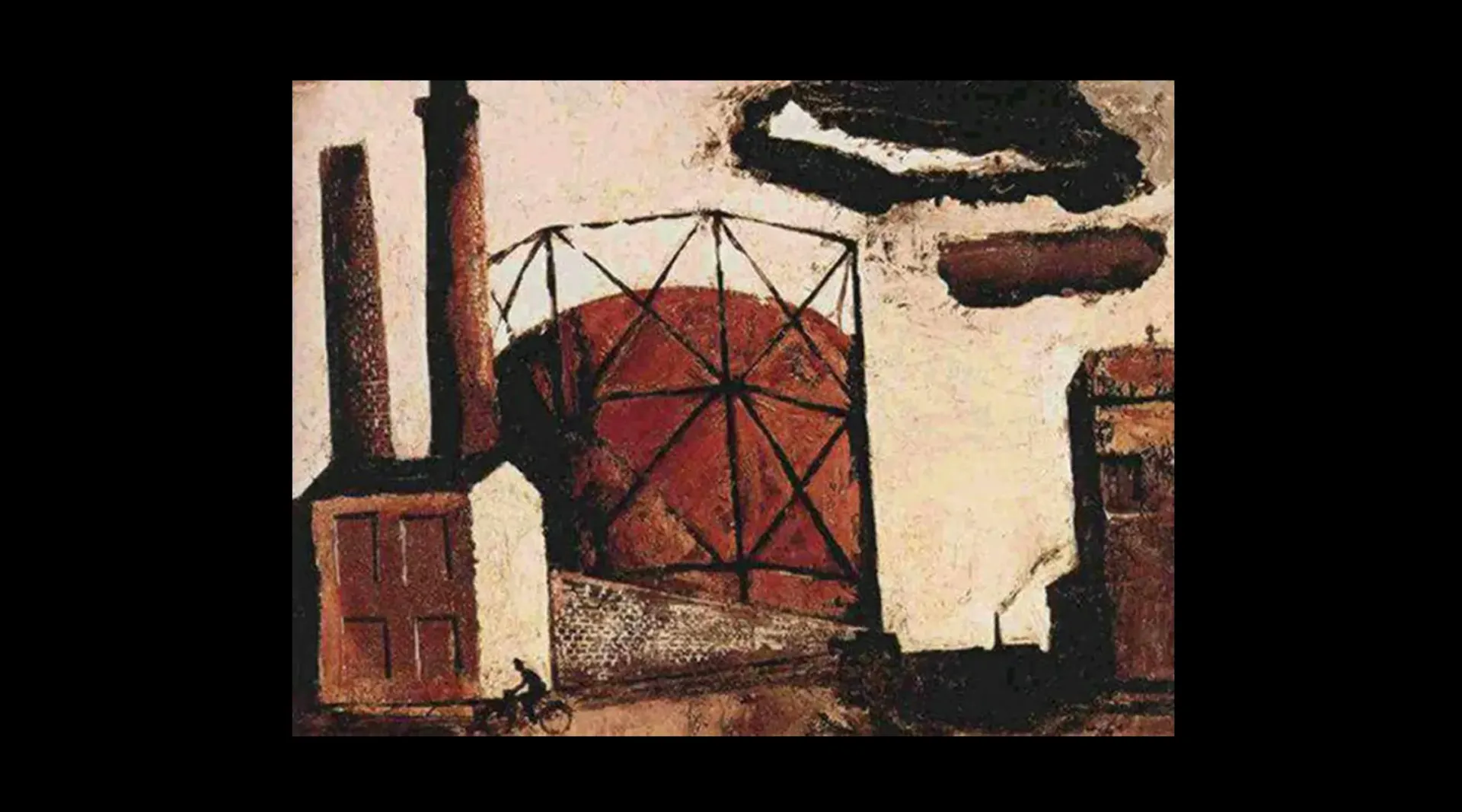
The Gasometer, a painting by Mario Sironi
GRAFFITI
A few decades later we meet Arno Hammacher, born in 1927, a Dutch graphic designer and photographer. Towards the end of the 1950s, Hammacher moved to Milan, where he lived for most of his life. Among other things, he documented the works for the construction of the Pirelli Tower for Gio Ponti, and collaborated with some of Italy’s most prestigious architecture and design magazines, such as Domus, Casabella, and Abitare. I discovered his work during one of my many online flâneries through archives and photographic collections — more precisely on the Lombardy Cultural Heritage portal — where I learned that, in 1992, Hammacher donated his photographic archive to the Region.
Among the many places his lens documented and narrated, there is also the Bovisa of the 1970s. Not so much in its large spaces, but on its walls: surfaces that host symbols and carry messages. The photographs show political graffiti scattered here and there: a hammer and sickle, an anarchist “A”. It is 1975 and, after a small intervention, that same “A” transforms: it comes alive, it smiles, it becomes the face of a little figure that seems to anticipate, by about ten years, the style and features of Fido Dido — a pop-graphic icon.
HELL
With a capital I, in Dantean memory. Bovisa was both a driving force and a set for one of the first European cinema blockbusters: in 1911 Milano Films produced a screen adaptation of the first cantica of the Divine Comedy, directed by Francesco Bertolini, Giuseppe de Liguoro, and Adolfo Padovan. Inferno — of which you can see a frame here — was among the most expensive films ever made in Italy up to that point. It was shot on a hectare of land in Via Baldinucci, where the company had a 650-square-metre studio, as well as on-location scenes, including on Lake Lecco.
Silent, and rich in tableaux vivants inspired by Gustave Doré’s illustrations, the film features Charon, Minos, Paolo and Francesca, Ugolino, and all the cantica’s unforgettable characters, all the way to the grand finale with Lucifer — with special effects that were pioneering for the time. At the premiere, at the Mercadante Theatre in Naples, the audience included Benedetto Croce and Matilde Serao, who commented the next day in Il Giorno:
“We, who have often detested the cinema for the banality and foolishness of its shows, last night made an honourable amends: we were gripped as if by the most imposing spectacle, and our spirits were shaken — and we plan to return. For us, Milano’s film of Dante’s Inferno has rehabilitated the cinema: for anyone, this show will be a true thrill of curiosity and emotion. […]”
Today, Bovisa still holds a few traces — faded but fascinating — of that extraordinary silent-film era. Among the financiers of Milano Films was the Armenian Hovhannes H. Zelilian, who in 1917 struck out on his own with Armenia Films, building his studios next to those of Milano Films. On one side of Via Candiani, right by the entrance to a public garden, an arched doorway still bears the inscription Armenia Films. It is a fragile vestige of a time when Bovisa was a little Hollywood.

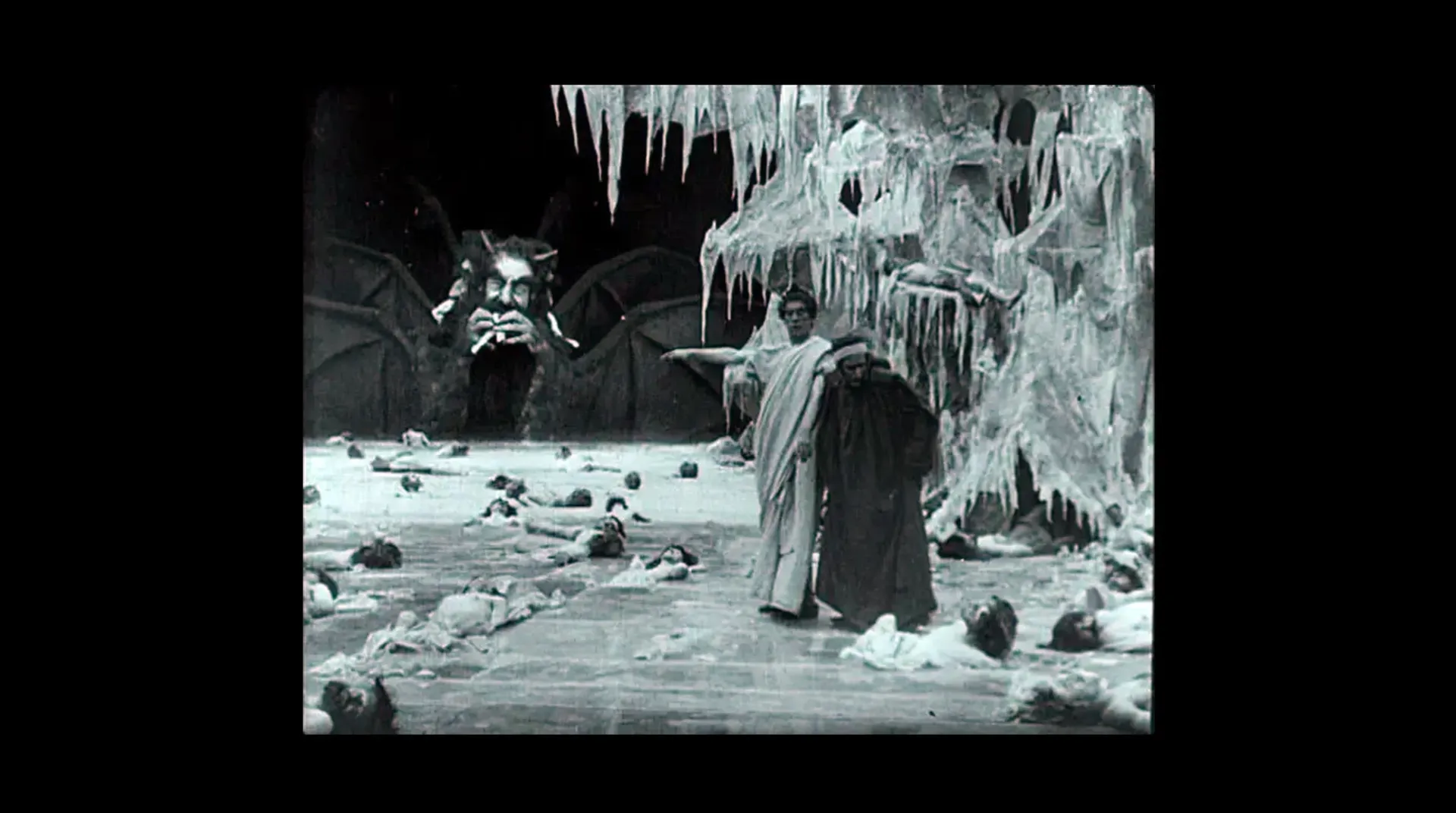
A frame from Inferno, the Divine Comedy, produced by Milano Films.
MADONNA WITH SMOKESTACKS
From Inferno let’s move to Paradiso, without stopping in Purgatorio. In 1917 the parish church dedicated to Our Lady of Good Counsel was completed, designed by architect Spirito Maria Chiappetta, who built numerous religious buildings across Lombardy. Here, though, we won’t focus on the church itself, but on a fresco to the left of the high altar.
The work depicts three cardinals: Andrea Carlo Ferrari, presenting the church model to Ildefonso Schuster; in the background, Giovanni Battista Montini can also be made out. What truly catches the eye — the image’s real punctum — is the industrial landscape of Bovisa behind Montini: the gasometer and smokestacks rise behind the sacred scene, creating a curious sense of estrangement within an otherwise fairly classical composition.
Above, the Madonna watches over the scene, enthroned with the Christ Child in her arms, surrounded and upheld by angels in traditional iconography. And yet, in the background, the real world opens up: Bovisa’s factories. An unexpected mystic working-class apotheosis — an ora et labora translated into the age of industrial civilisation.
The signature at the lower right suggests the fresco dates to 1959, painted by the Bergamo-born artist Pasquale Arzuffi, author of many religious frescoes in churches, basilicas, and shrines. Fun fact: for the future Pope John XXIII — then Apostolic Nuncio, and also from the province of Bergamo — Arzuffi would later produce several works in Sofia, Athens, and Istanbul.

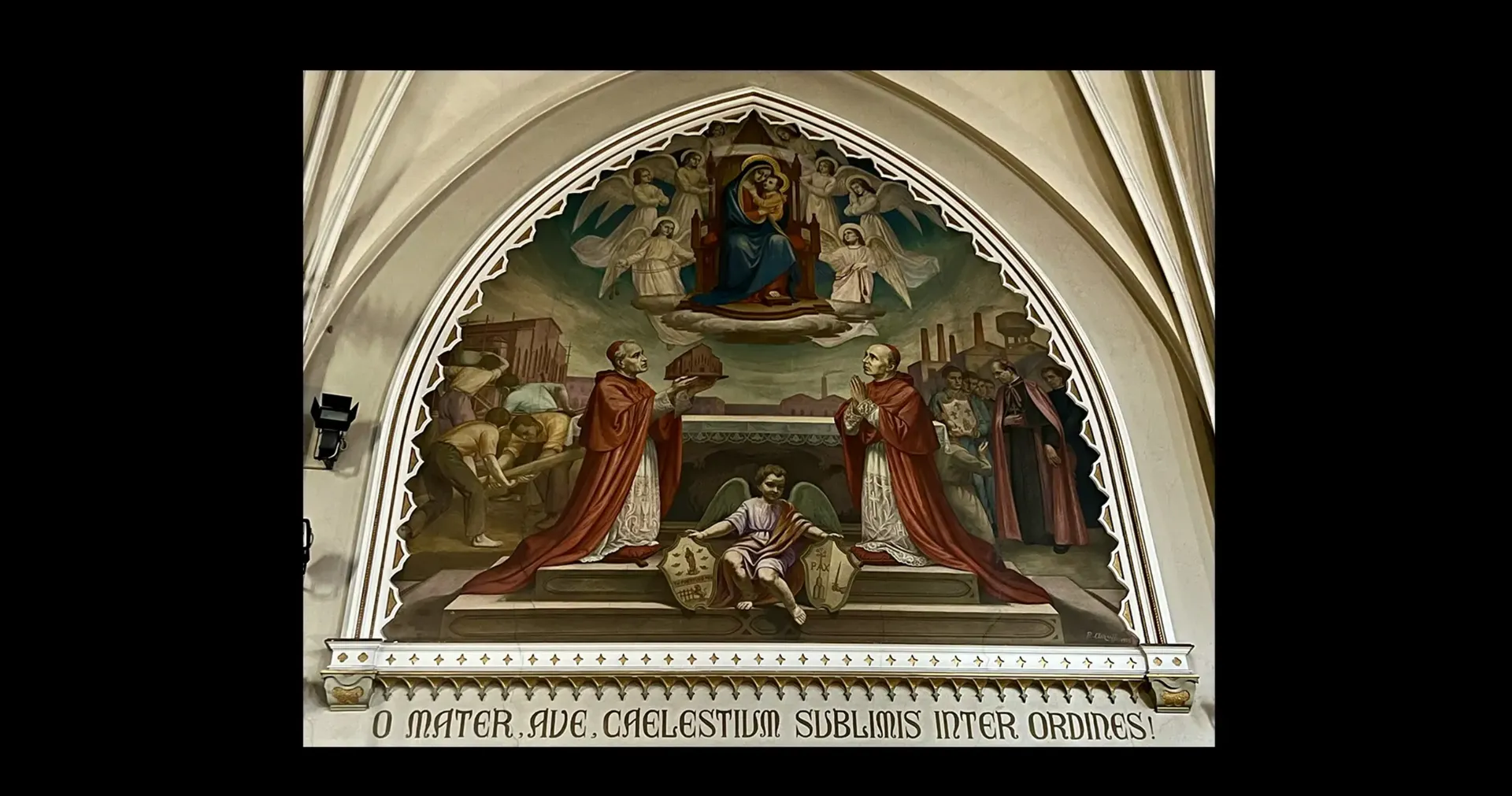
A fresco in the parish church dedicated to Our Lady of Good Counsel.
HIDE-AND-SEEK
EErmanno Olmi — filmmaker and a “Bovisa kid” — recalls the carefree years of his childhood on Via Cantoni in his 1986 book of the same name, a screenplay for a film that was never made:
“We mostly played in the street. The street was our entire world. We didn’t even imagine that, in our future, there could be anything different from that street and those friends of ours. If there was a ball, then we’d play endless matches, lasting the whole afternoon…”
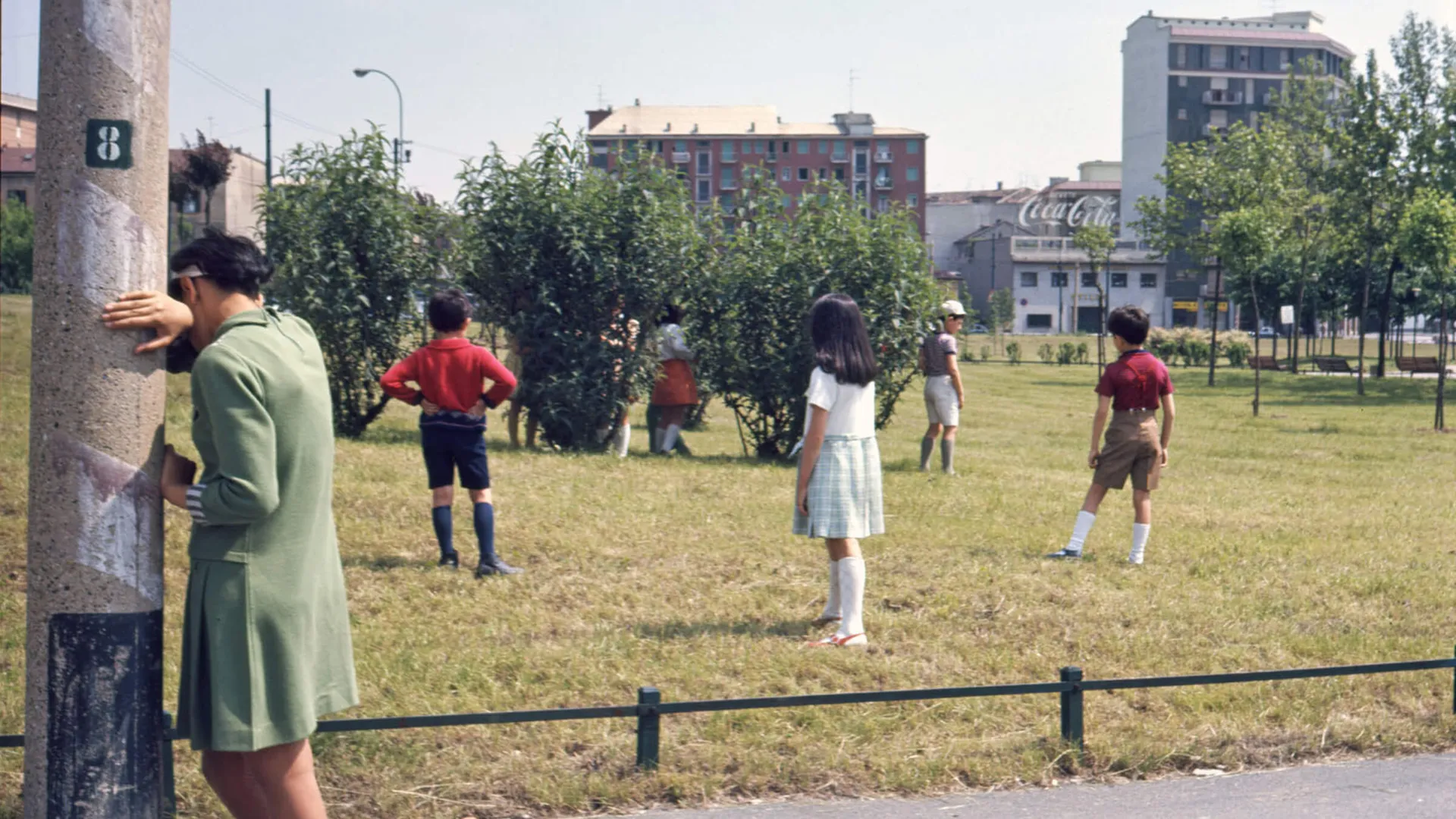
Olmi is describing a period spanning the 1930s and 1940s, yet nearly thirty years later it seems that little, if anything, had changed. The street remained the centre of children’s world, as we can see in this 1960s photograph by Ando Gilardi. Children are playing hide-and-seek in a small garden near Piazzale Lugano in Bovisa, just a few hundred metres from the church with the fresco we mentioned earlier. It is 1969, and Gilardi took a series of photographs for a study on outdoor games. Other images show children running, playing “statues”, or tug-of-war.
Ando Gilardi was a pioneer: he effectively invented iconographic research in Italy, and was not only a photographer, but also a theorist of the image and an tireless scholar of visual culture.
In 1959 he founded the Fototeca Storica Nazionale in Rome — later the Fototeca Gilardi — with the aim of collecting images for editorial publications and other uses. In 1967 he moved the archive to Bovisa, to its current home on Via degli Imbriani.
Today the collection holds over 40,000 images, and it also has a recent digital catalogue dedicated to Gilardi’s work — free, and full of wonders and archival gems: from the stunning photographs taken during anthropologist Ernesto de Martino’s travels in Southern Italy, to the many curious little “flying” objects that crowded Gilardi’s studio.

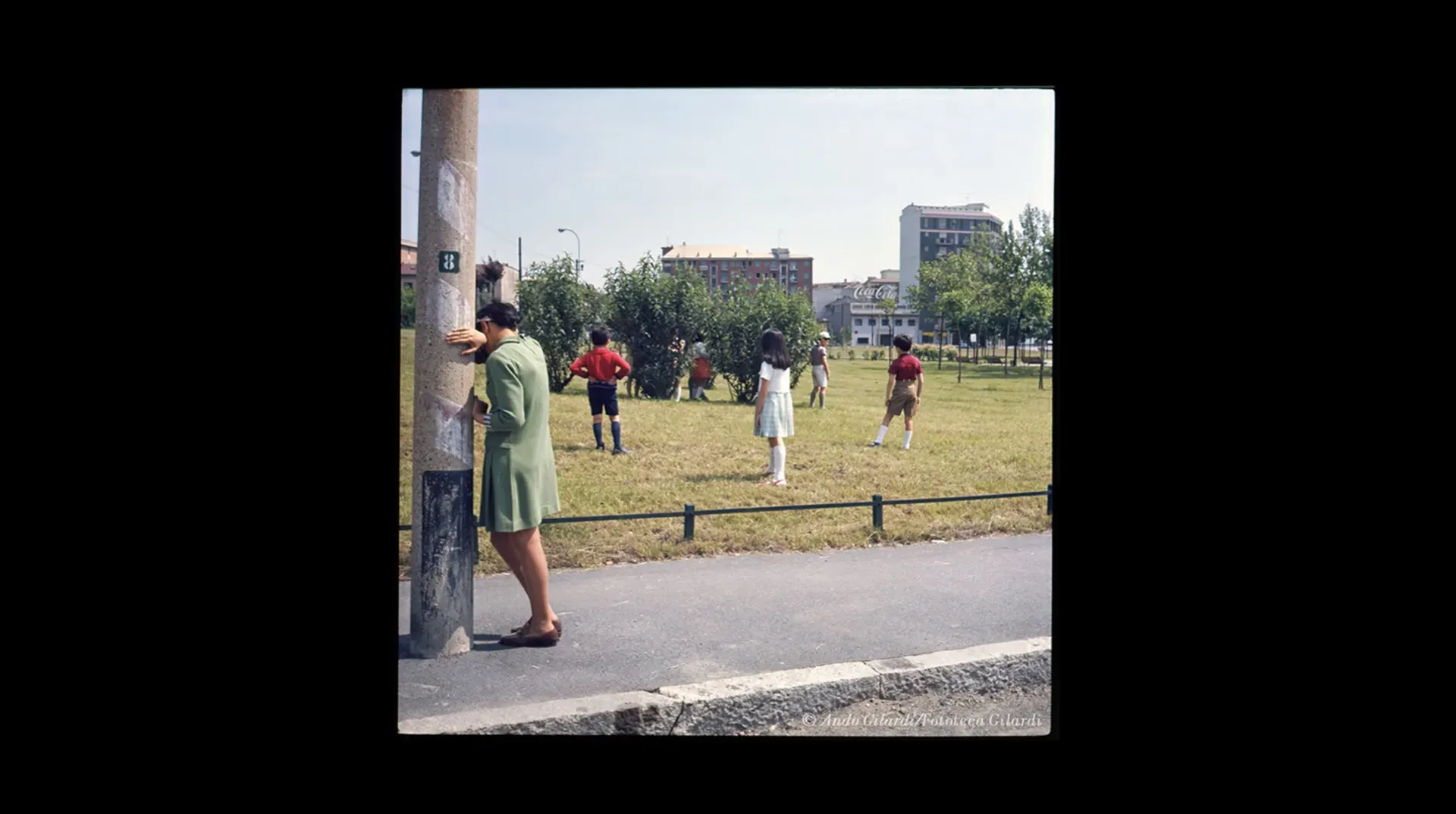
Children playing hide-and-seek in a small garden near Piazzale Lugano, Bovisa © Ando Gilardi / Fototeca Gilardi
RASPBERRIES
There are no images here. So I take Ando Gilardi’s iconographic lesson to heart and place alongside it a relevant image from the period: raspberries taken from a small Hoepli handbook on red berries — Hoepli being a historic Milanese publishing house. Yes: raspberries in Bovisa. A surprising detail, straight out of a classic “Perhaps not everyone knows that…” column.
The story concerns the area around Piazzale Lugano, already mentioned in connection with children’s street games — a reminder that every fragment, every detail, is connected to the wider fabric of everyday life and collective memory.
“Seventy years ago, near that large, open space that today has been renamed Piazzale Lugano, in the semi-peripheral area of Bovisa, there stretched wide fields where raspberries were grown. At the time you would have seen women, with large baskets hanging from their necks, picking raspberries by hand. The fruit was then washed, sorted, and placed into large containers. Every morning, two or three lorries would transport them to Sesto San Giovanni, an industrial area in the north-west of the city. There, the raspberries were used by Campari — which had (and still has) its largest industrial site in Sesto — to produce the unmistakable reddish colour of Campari Bitter, an aperitif consumed around the world. Then, around 1935, the unexpected happened. In the USA an insect was discovered — a kind of ladybird — that produced the same red colouring at a far lower price. Bovisa’s raspberries were abandoned. Production collapsed. Soon the land was sold to industrialists or real-estate speculators…” (John Foot, Territorio magazine, 2007).
It also makes me think of Cordial Campari, a mythical liqueur (now discontinued) produced in those years, made from wild raspberries macerated in cognac and then distilled. Did Bovisa’s raspberries end up in the blend? Time will tell. Though in the neighbourhood the real heavyweight of liqueurs is Fratelli Branca, producer of Fernet-Branca, in its historic headquarters on Via Resegone: the giant corner lettering and the chimney catch the eye of anyone travelling along the ring road on Via Lancetti.

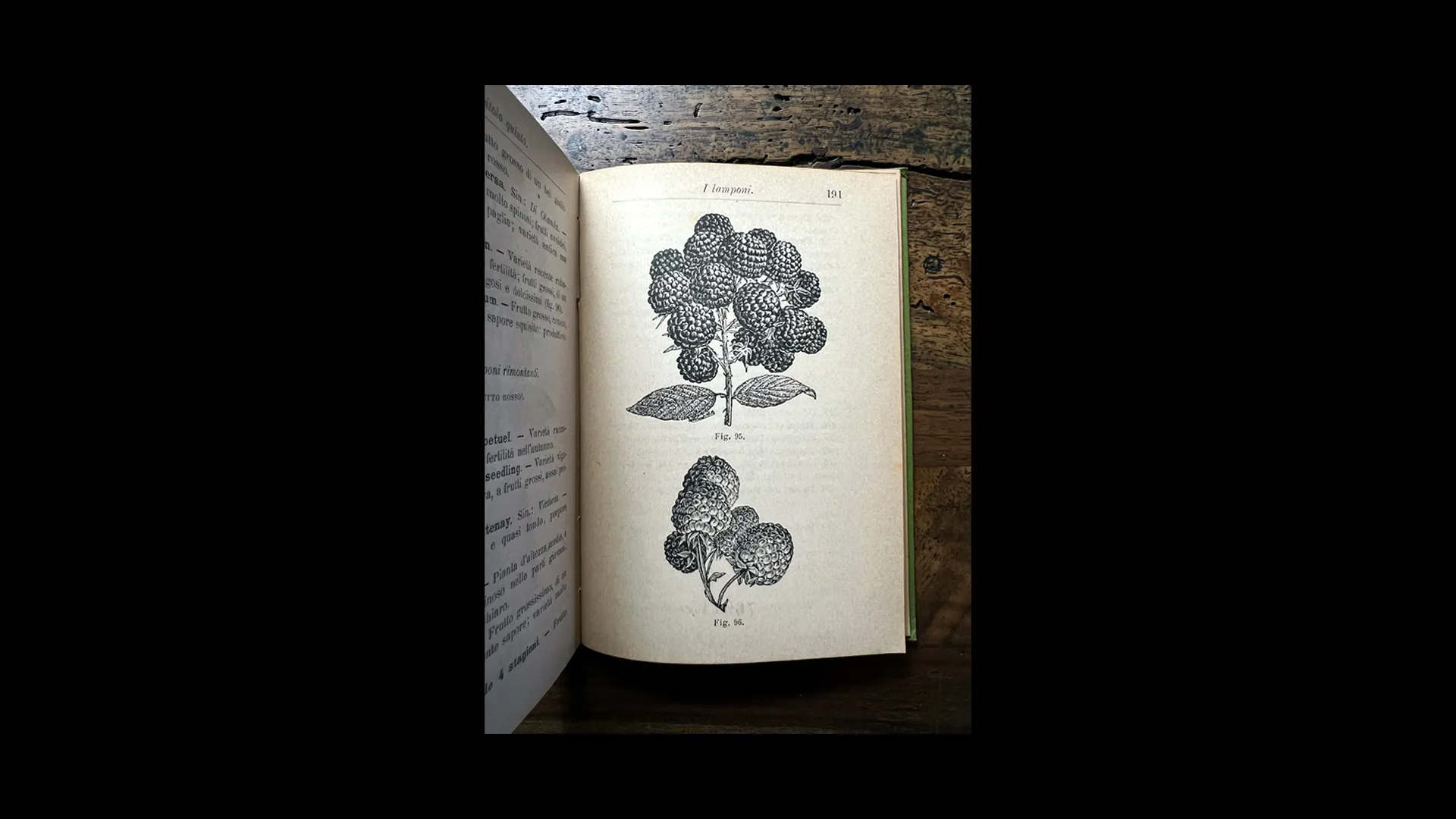
Raspberries, from a small Hoepli handbook on red berries.
STATION
f the hermit Giovanni seemed to have found his serenity in the fields where Bovisa station would later rise, the history of the rail yard — inaugurated in 1879 — was not always so peaceful. In 1916, a terrible explosion at a neighbouring factory, the American Boston Blocking Company, caused seven deaths and went down in history as the Bovisa Disaster. What we see in this 1982 video is still the old station, demolished in 1988 to make way for the new building inaugurated in 1991 — the one we know today.
After so many still images, I close this little illustrated glossary of Bovisa with moving ones. These shots are among the last visual testimonies of the old station, the protagonist of a videoclip made for a Rai feature that included an interview with Matia Bazar. The band is accompanied by a mix of “Fantasia” and “Lili Marlene”, tracks from their new album Berlino, Parigi, Londra, which marked the beginning of their more electronic, new wave phase — with a renewed line-up and Mauro Sabbione on keyboards.
Antonella Ruggiero and the others stride towards the station and board a “supposed” steam locomotive: in reality, a wooden vintage carriage pushed by a modern one, with smoke created using dry ice. The theatrical trick holds, and the band projects — metaphorically — both itself and Bovisa’s past towards Europe and the future. The filming took place at two in the morning, to avoid the crowds and daytime commuter chaos.
That same movement of travellers was captured in the verses of Bovisa, a lyric by the urbanist-poet Giancarlo Consonni:
“It throws out youth,
the station of Milano-Bovisa.
Just outside,
trusses of beams,
sagging roofs,
the lament of ruins
(it is the Sirio factory
decomposing)
The chimney intact,
it leaves us to our steps”
Livia Satriano. Livia Satriano è ricercatrice, autrice e curatrice. Ha scritto libri, ideato format e condotto talk, programmi radiofonici e podcast. E’ fondatrice della pagina Instagram Libri Belli.