
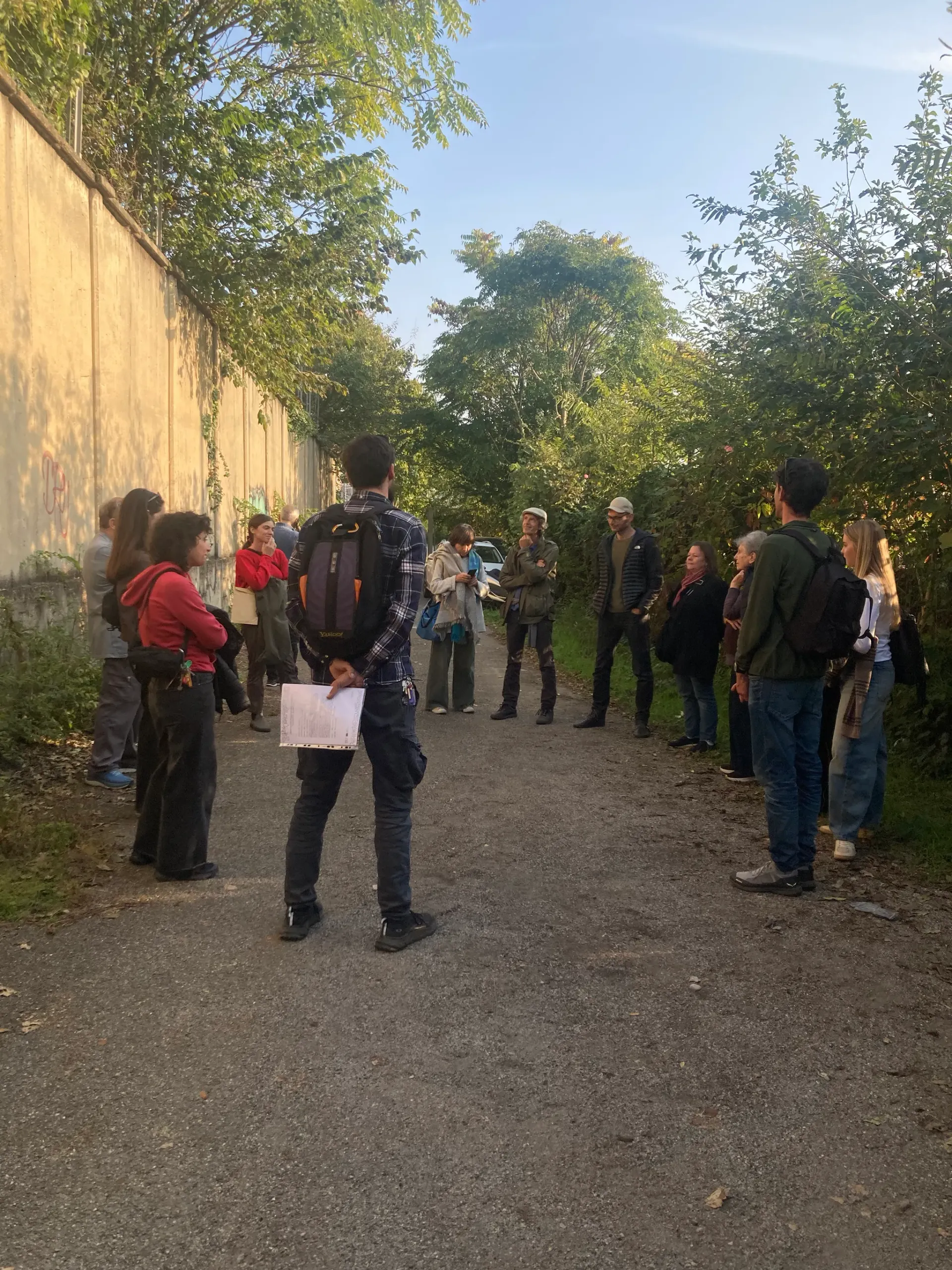
The Goccia area is separated from the rest of Milan by high perimeter walls and railway embankments, so much so that many people pass by its edges every day without imagining what lies beyond the fence: an 18-hectare forest that has grown spontaneously among the ruins of a disused industrial plant. Yet, if you open a map and look at this same area from above, from a bird's eye view, the perspective changes and you realise not only the actual size of the area – with its green wall crossed by no paths and therefore so different from any city park – but also how deeply La Goccia is embedded in the urban fabric.
To the east lies the historic working-class neighbourhood of Bovisa, with its early 20th-century buildings and industrial plants, some abandoned and some converted, and then the neighbourhood of Dergano, merged with Bovisa in terms of urban planning but very different in terms of history and vocation. to the west is Villapizzone, with its small square of the same name that confuses visitors, making them think of a small village; to the north lies Quarto Oggiaro, one of Milan's best-known and most talked-about suburbs; to the south, Ghisolfa and Mac Mahon, with their echoes of Testori, and a little further on, Scalo Farini, an urban void about to become a city in its own right.
When considering the future of such a large, complex area deeply rooted in a heavily man-made context, it is good practice – unfortunately not so common – to take time before acting. What is the idea of the city that we want to convey? Is it possible to move beyond the single logic of the park? Are there alternative paths to those usually taken? And what are the needs, expectations and desires of the communities that live around it in the present and will frequent it in the future? These are just some of the many questions that Kilowatt, a workers' cooperative with years of experience in urban regeneration issues, is trying to answer. After renovating and converting the Serre dei Giardini in Bologna in 2015, which it now manages as a cultural production hub, Kilowatt has developed an internal working group that provides consultancy for the launch or development of projects with social, environmental and cultural impact objectives.

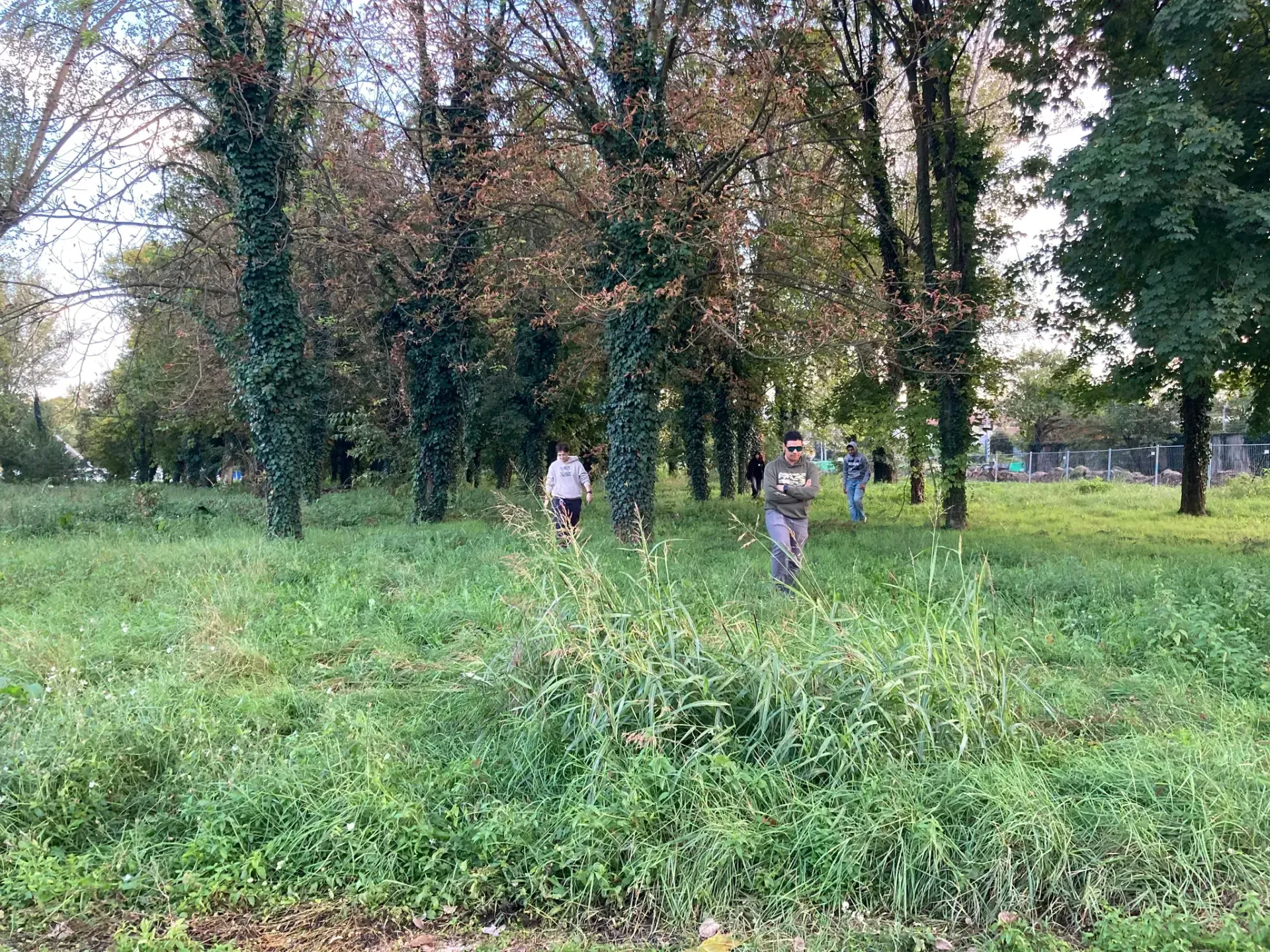
A moment from a performance staged during the workshop activity © Cecilia Colombo
«As part of the Goccia project, we are conducting ethnographic research with the aim of collecting qualitative data that will allow us to develop a hypothetical governance model for the future management of the area and a hypothetical usage model, i.e. how this area will be traversed and frequented by the population,’ explains Cecilia Colombo, project manager at Kilowatt. ‘One of the objectives is to try to overcome the anthropocentric approach to urban parkification. So, to understand how we can think of La Goccia as a forest in the city and what relationship this forest will have with the surrounding neighbourhoods and with the general public».
This research project began in January 2025 and will continue until early 2026, when the large amount of data collected will be systematised and a number of scenarios for different possible models of area management will be developed.
«Ours is a constructivist approach, which differs from the classical sociological method,’ Gaspare Caliri, co-founder of Kilowatt, tells me when I ask him to go into detail about the research he is conducting together with his colleagues Cecilia Colombo and Samanta Musarò. 'Essentially, from the point of view of classical sociology, the analysis of the relationship between subjects existing in a territory starts from the given categories of these subjects, i.e. from the way they are pigeonholed: people are young or old, poor or rich... then, based on the selected categories, the research is developed. A constructivist approach, on the other hand, starts with no categories, preferring to build them step by step, together with the accidents and encounters that occur along the way.»
In short, it means approaching the object of research, in this case La Goccia and the communities that live around it, with as open a mind as possible, without preconceived ideas. An exercise in humility, if you like, which requires a great propensity for listening, something that is far from common in a society like ours, not to mention a city like Milan, where there is often no time to stop and observe.
«The constructivist approach is very useful in a context such as La Goccia,' continues Caliri. His tone is passionate, and he often indulges in suggestions ranging from the philosopher Gilles Deleuze to the psychogeography of the 1960s. 'The moment you enter it – and I use the word “enter” intentionally, because in a place like this you don't just enter physically, but also symbolically and relationally – you realise that you have no categories to understand it. I mean, what is it? Is it a former production plant? An urban forest? Is it part of the city? It may be all these things together, but it is also much more: it is a place that breaks down categories, polarizations, dichotomies.»
I understand what he means: La Goccia thrives on contrasts, on antinomies, a space that is different from both the urban context in which it is located and the wilderness we usually associate with the word ‘forest’. The ground is covered with soil, grass and brambles, just like in a forest; yet, if you dig a little, almost everywhere you find concrete and asphalt, often cracked by tree roots. It is an untamed place that fascinates and repels at the same time. Once inside, you may feel disoriented and feel the need to listen, as happened to Caliri; or you may see it as a source of inspiration, something to learn from, as happened to Colombo; as for me, I was fascinated by the margins, by what is spurious and shuns the everyday. In any case, it is impossible not to perceive its complexity.

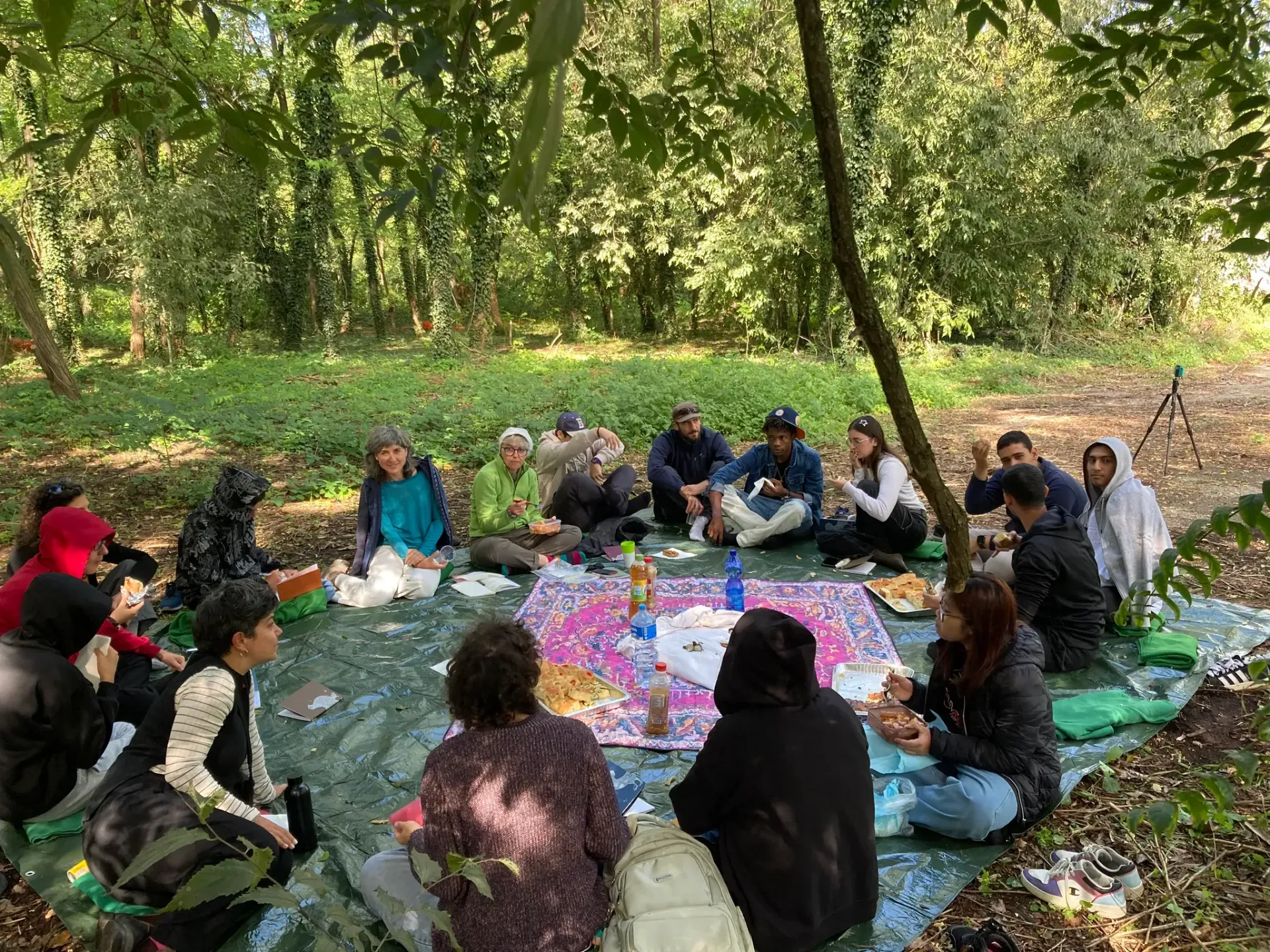
The Sunday picnic that kicked off Kilowatt's residency © Cecilia Colombo
But how does this ethnographic research actually work?
«We started by interviewing those who have most frequently visited, observed, and studied the area in recent years, namely the other members of the La Goccia Observatory, from Terrapreta, promoter and coordinator of the Observatory, to the Natural History Museum of Milan, from the CNR to the Urban Forestry Center – Italia Nostra... It was an initial internal phase, designed to establish a strategic alignment with regard to the vision and direction to be given to the research», Cecilia Colombo tells me. Compared to Caliri, Colombo describes their project in a more linear and concrete way, but I recognize the same passion in her words as in her colleague's. «We then consulted with some experts outside the observatory, interacting in particular with those who have a humanistic view of ecological thinking. A fundamental aspect that emerged across the board during the course of this year is precisely the importance of hybridizing the scientific and humanistic perspectives as much as possible, in order to propose a truly cultural transformation in relation to the relationship that citizens have with wildlife in the urban context».
The impact goal that emerged is as stimulating as it is challenging: to make La Goccia a living laboratory in which to observe, experiment, and disseminate practices of ecological coexistence capable of transforming the way we think, design, and inhabit cities.
However, in order to pursue this vision while avoiding decisions being perceived as imposed from above, far removed from the desires and needs of individuals, a further step is necessary: consultation with local communities. The next round of interviews was therefore conducted with citizens and organizations active in the surrounding neighborhoods.
I also live in this area, and in the list I am shown, I recognize the names of many organizations that have been working in the area for years, performing a fundamental, and sometimes complicated, socio-cultural function: the historic Arci la Scighera, the Scamamù bookshop, the BovisAttiva citizens' association, the ETS L'amico Charly, the Nuovo Armenia and Rob de Matt cultural and recreational spaces... The area around La Goccia is a unique context, a collection of very different neighborhoods, clearly separated from each other by the presence of La Goccia and the railway belt, but all facing a period of significant transition, between pressures of gentrification, challenges related to integration, uncontrolled price increases, and a lack of attention from the municipal administration.
«By meeting with residents of the neighboring neighborhoods and organizations that have been working in the area for years, we tried to understand together with them what historical imagery has been layered over the years and, above all, what this forest could become for the communities that gravitate around it», explains Colombo.
As is to be expected, many suggestions emerged. One that particularly appealed to me was the proposal to map and then connect with La Goccia the other unconventional, sometimes liminal green ar»eas in the northwestern quadrant of the city: from the vegetable gardens in Via Bovisasca to the library garden in Villapizzone, to geographically more distant but culturally similar projects such as the Giardino degli Aromi (Garden of Aromas) at the former Paolo Pini (Affori) and the Aurelia Josz Botanical Garden (Niguarda) – all of which do not fit the definition of an urban park.
Up to this point, I have always referred to ‘interviews’, but perhaps the more correct term would be ‘chats’. The direction of the conversation and the topics explored vary depending on the subjects involved, while the questions are open-ended, evocative, leaving room for imagination and interpretation, often generating further questions and comparisons, in what is effectively a continuous repositioning of the conversation. There are questions such as: “If you could be a living being (or an element) inhabiting La Goccia, what would you be and why?” (answers include: oak trees, earthworms, water, woodpeckers, even bacteria) and “If one person were to decide the future of La Goccia, what book would you give them?” There is also a request to comment on a series of dichotomies (among others: “nature/culture,” “individual/community,” “private/public,” “protection/use,” “ecosystem regeneration/urban regeneration”).
The synthesis activity, as mentioned, is ongoing, but interesting ideas are already emerging. For example, the desire to prioritize natural remediation systems (phytoremediation) as a priority strategy for the future in the area and the need to promote a cultural and political process to support it over time, as well as the desire to look at La Goccia as a training ground for a different, non-anthropocentric point of view.
«La Goccia is a third place, neither natural nor urban. The challenge is to relate to it as a place detached from the categories we normally use to observe greenery in our urban daily lives, but which is at the same time accessible to neighborhoods and citizens», Caliri explains. «Other things, this could translate into the decision to keep certain areas of the site off-limits».

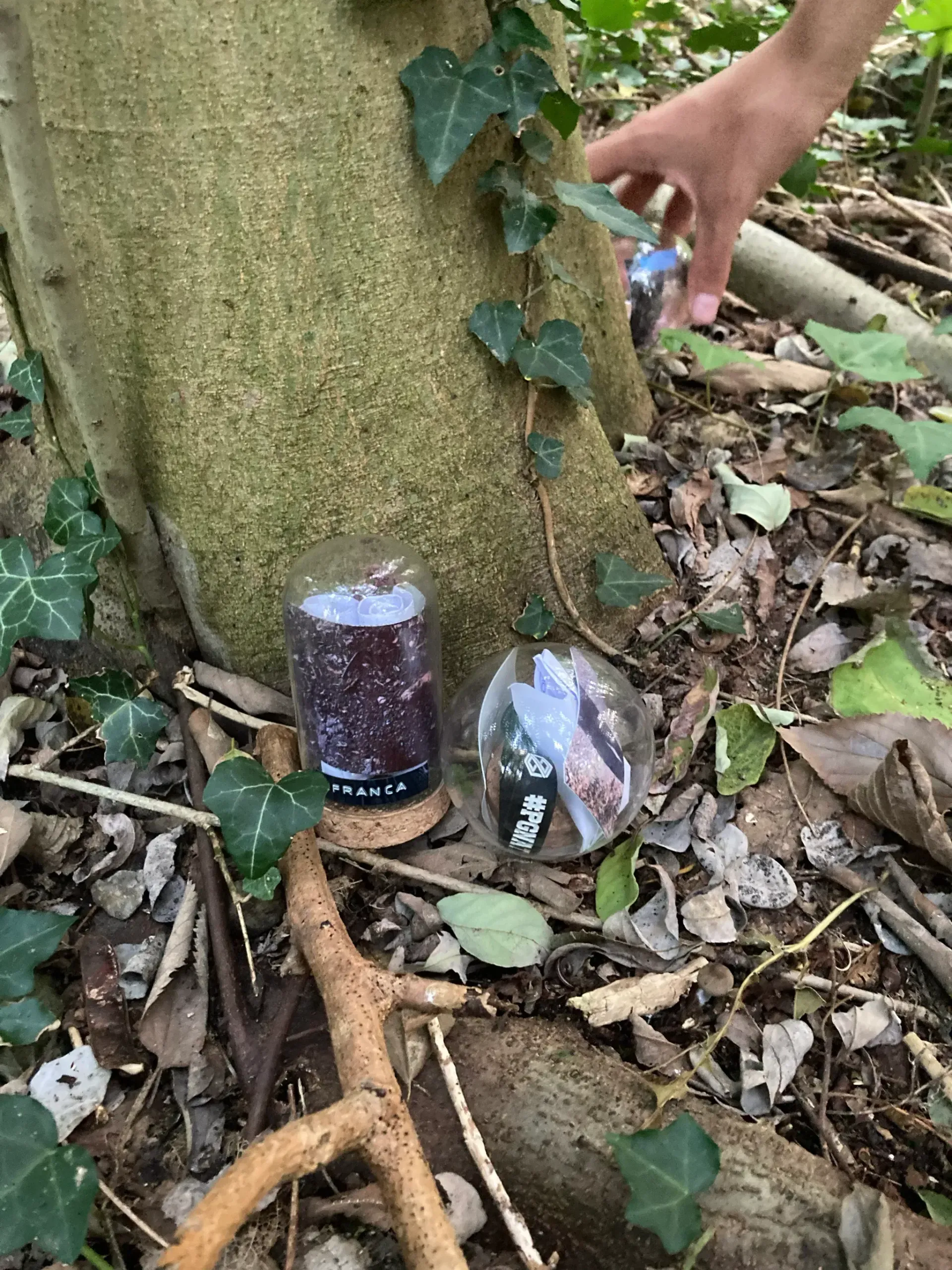
Time capsules filled during Kilowatt's residency © Cecilia Colombo
But the theme that strikes us most, and which emerges in many conversations, is that of time. Approaching La Goccia with a non-anthropocentric perspective means realizing that time flows differently there than in the rest of the city, and that we need time to listen to (and try to understand) what this place wants to tell us. It takes many decades for a forest to grow, while cities are designed for quick, immediate use. We who live in them therefore have few tools and few opportunities to relate to such an extended temporality. So perhaps the greatest opportunity that La Goccia is offering us is to realize that there are other ways of living and imagining cities, and that the time has come to experiment with them. As Cecilia Colombo says: «La Goccia is a place that encourages us humans, who live in a capitalist, hyper-productive, hyper-fast society, to embrace uncertainty and accept all the time necessary for this place to evolve».
Michele Turazzi. Michele Turazzi lives in Milan and works in publishing. He has published the novel Prima della rivolta (Nottetempo 2023, winner of the Demetra Prize for Environmental Literature 2024) and the narrative reportage Milano di carta (Il Palindromo 2018).