
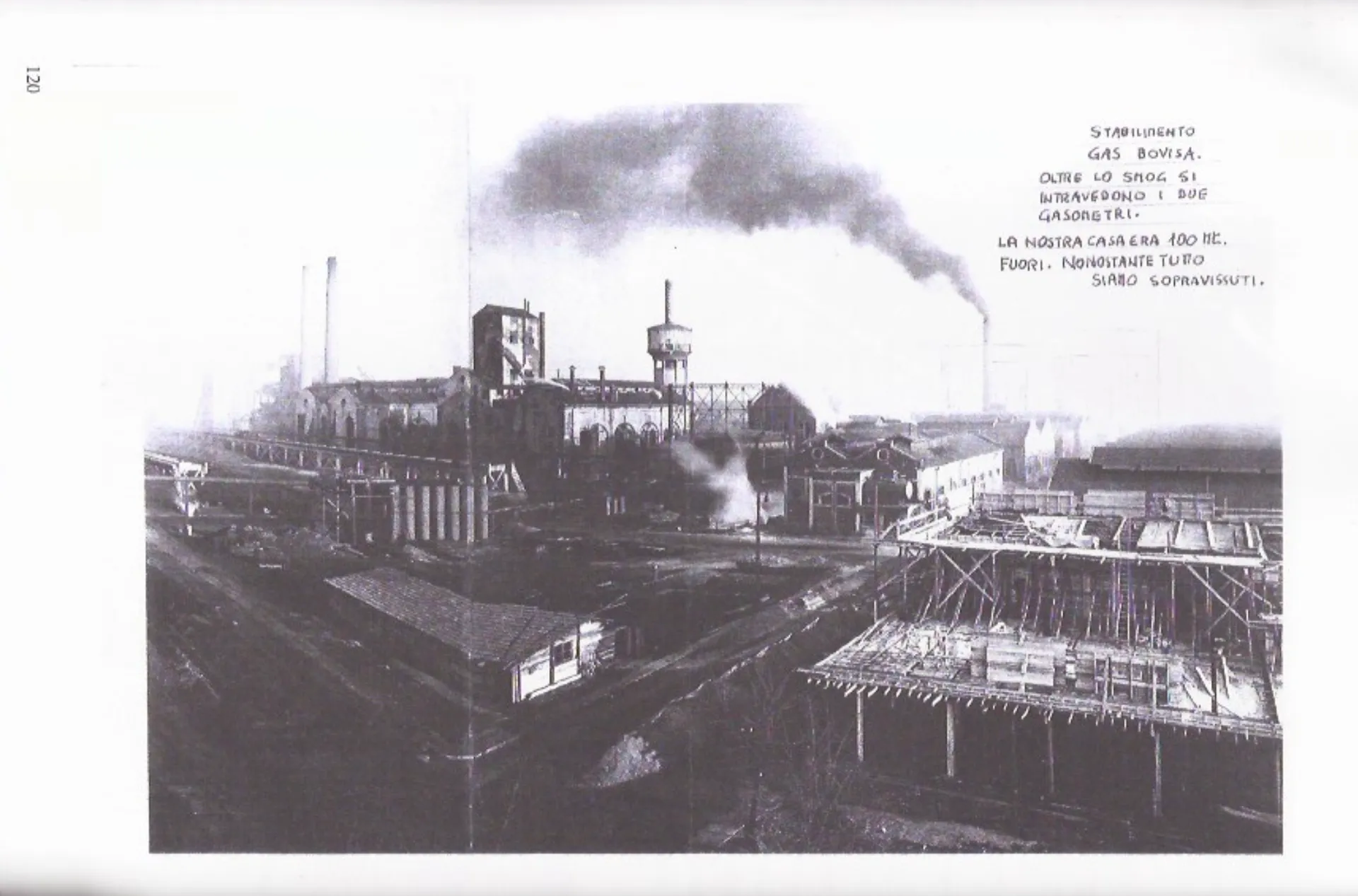
So there is a manuscript, which Giovanni Parolini, known as NonnoNino, born in 1938, placed at the very centre (or so I like to imagine) of a circle of boys and girls. From the centre of that circle, the manuscript ended up on my screen: a message in a bottle, dematerialised and broken down into 162 files, one scan for each page. I went through them all. Then I got into my car and drove to what NonnoNino calls the Mungüss square. In the hand-drawn map he made, it is a triangle formed by the intersection of Via Giampietrino, Via Codigoro and Via Lambruschini. Today, it is a circle: a cobblestone roundabout, with a white-painted chair at its centre. Beneath that roundabout once lay an air-raid shelter from the Second World War.

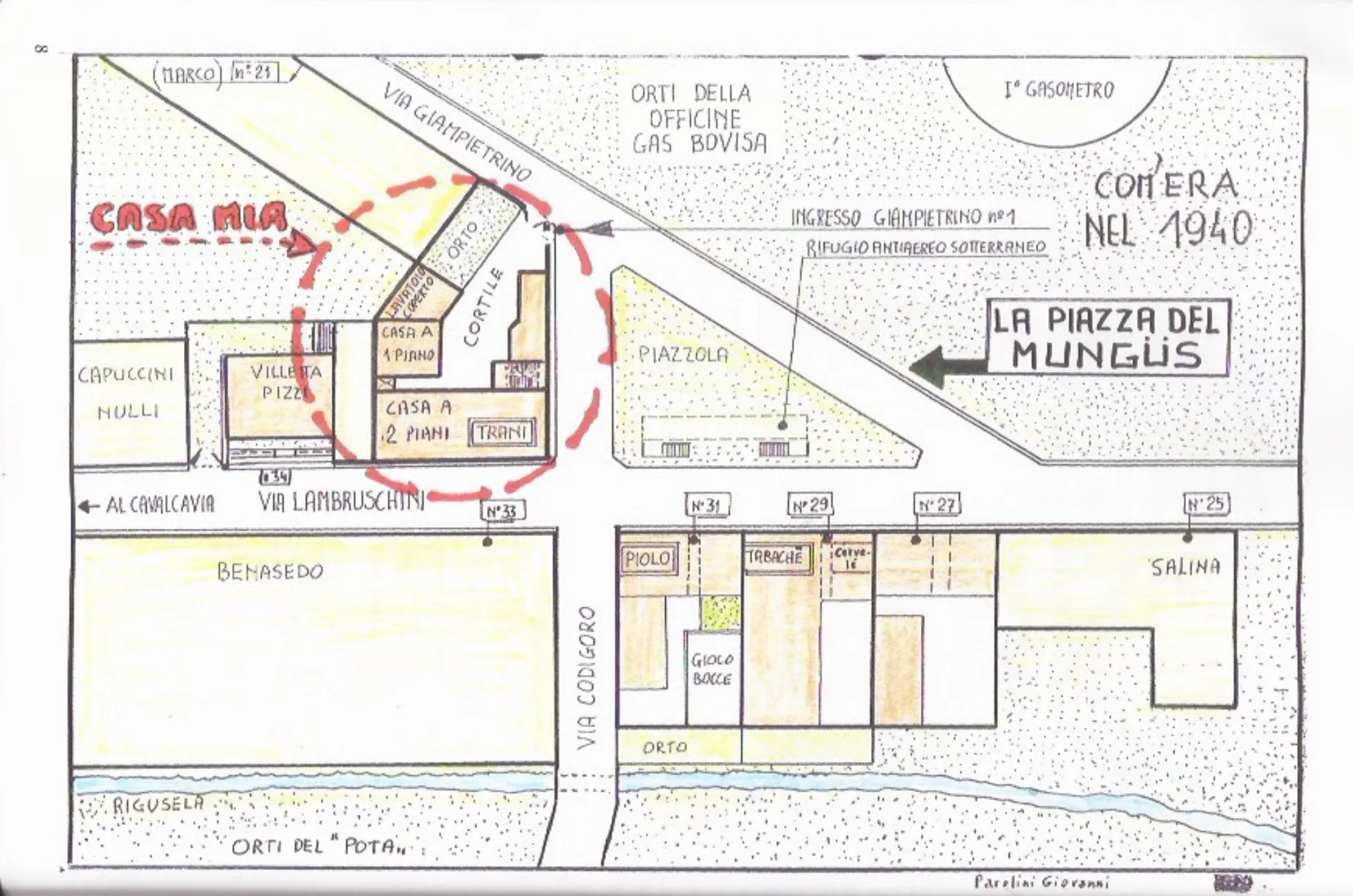
A map of Munguss in 1940. Drawn by Giovanni Parolini
“When the alarm sounded — a siren from the Officine Gas Bovisa — everyone had to leave their homes and head to the underground shelters,” NonnoNino writes. “We had two choices: the cellar of our apartment building, or a reinforced concrete shelter outside the courtyard, underground in the little square of the Mungüss. That shelter was much safer than our shared cellar, especially in case we survived a bombing but were buried under the rubble.”
I drive around the roundabout twice. No trace of the shelter. I circle it once more. Finally, I park nearby. I return on foot, to look more closely. Since it is there, I sit down on the white-painted chair. In front of me, I recognise the building where NonnoNino was born and raised. In his hand-drawn map, it is marked with a dashed red arrow reading “MY HOME”. A casa di ringhiera that housed several families, on two floors, with a courtyard, a covered washhouse, and a vegetable garden.
“I used to play the accordion outside the house, on the railing” — on page 74, NonnoNino introduces the accordion for the first time, an instrument that will reappear in several passages of the manuscript — “or inside the house, with doors and windows open, to the great joy of my mother and myself. Or downstairs, in the trani, with friends and fellow tenants of the building.”
The trani were something halfway between a bar and a tavern: bottle shops where people brought food from home and drank strong, unbottled wine that arrived from Puglia (hence the name). Where the trani of the manuscript once stood, today there is a place called Stessa Direzione, Breakfast, Lunch Café, Lounge Bar. Without getting up from the chair, I zoom in with my phone and take a picture of it.
“One of my cousins, who lived on Via Lambruschini, used to call me over to her place at least once a week to listen to La cumparsita. It was a sign of my destiny: to that music, in a dance hall, about ten years later, I bound myself for life to my Silvana.”
CHILDHOOD, WAR, GAMES, BOOGIE-WOOGIE
On the manuscript’s front page there is a passport photograph of Giovanni; below it, framed in red, a quote by Emily Dickinson: “Some say that when the word is spoken, it dies. I say instead that, if it is also written, that very day it begins to live.”

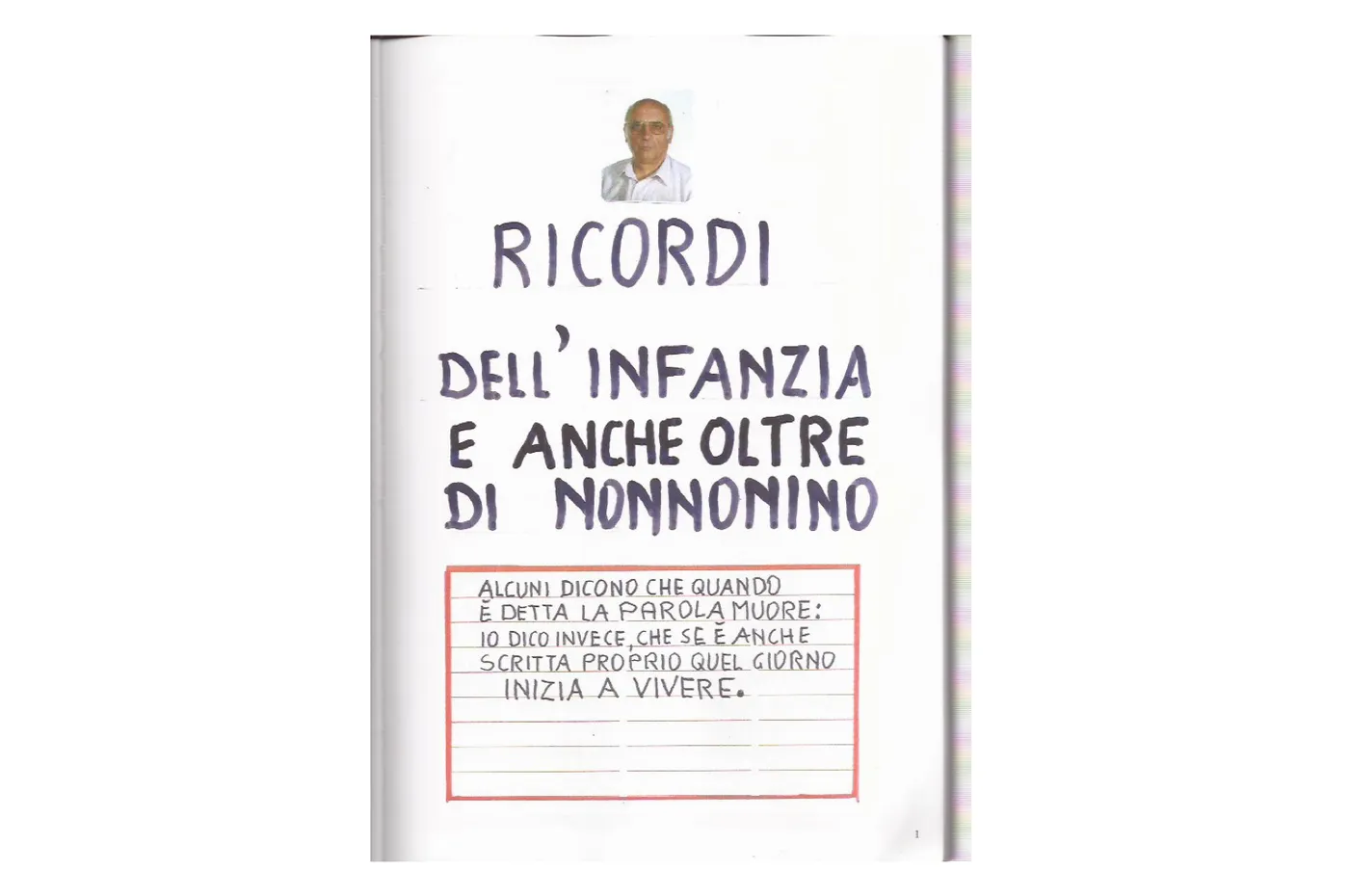
The front page of La Mia Bovisa. The manuscript of Giovanni Parolini
NonnoNino’s vivid memories come to an end more or less where his love for Silvana begins — the woman who would become his wife and the mother of his children. Before that threshold lies “a suburb filled with sounds and smells: the sirens marking work shifts, the footsteps of workers, the smell of workshop grease that still comes back to my mind and into my nostrils.” There are plants and hedges, “the hair that my mother used to stroke.” There are “Elio, Lino, Ciccio, Nando, Giorgio, Gianni, Pino, Pasquale, Annibale, Graziella, Teresa, Ivana, Cesarina, Luciana, Camilla, Grazia, Angela, Mariuccia (the famous Mungüss gang).”
Before that threshold there is the barking of Lampo, the dog adopted by the whole neighbourhood. The sly silences of Gigetto, the stray cat. The trilling of the duplex telephone. The calls of street vendors. There are games: el tutü, la lipa, nascundès, bow and arrows, el ciapàass, slingshot or tirasàss, blowpipe, carelott, scooter, tug of war, i tulìtt.

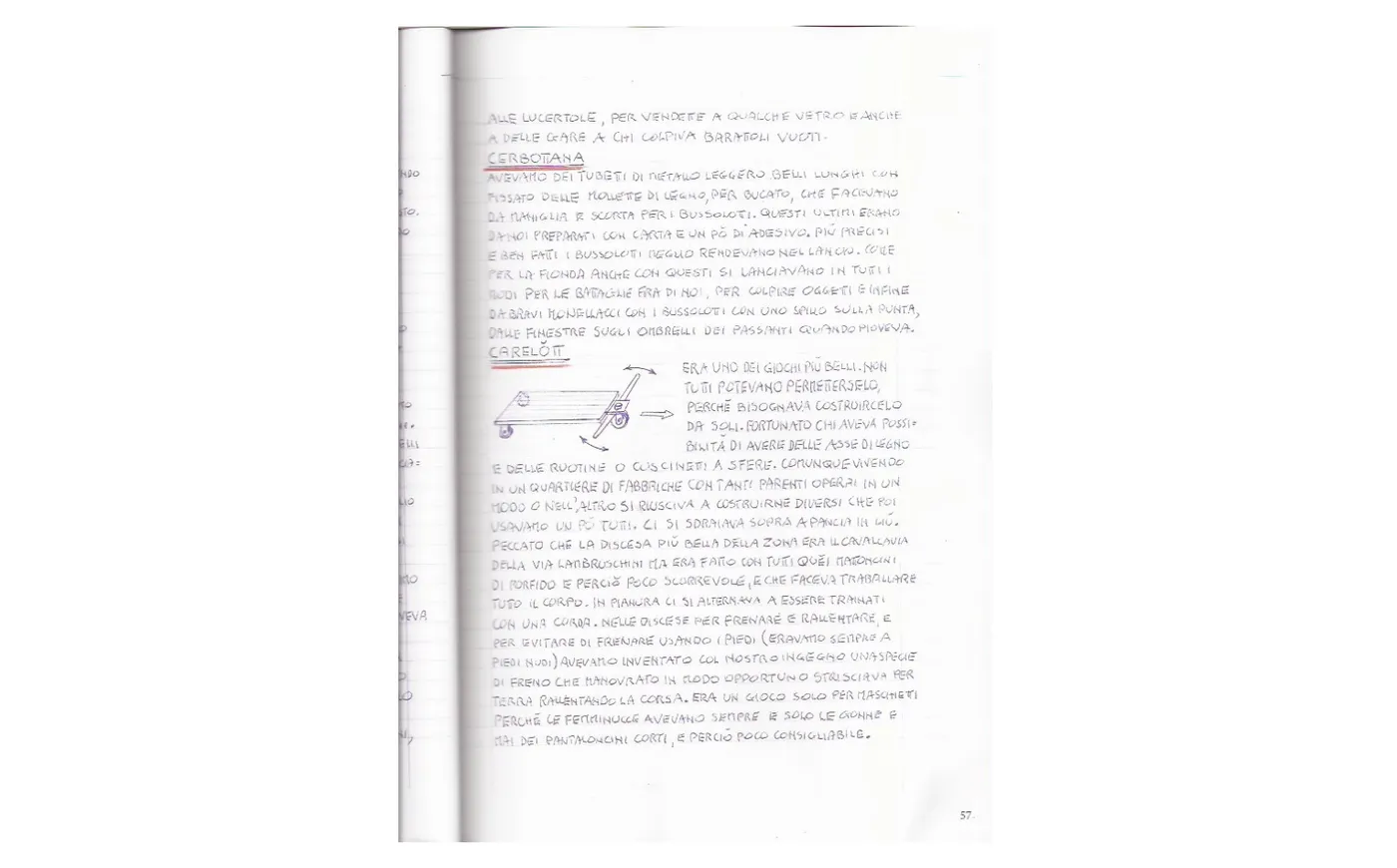
The games of Giovanni Parolini and the others friends of Munguss
There are the horrors and the everyday normality of war: the roar of aircraft, the crash of bombs; a lonely woman who, whenever the alarm sounded and it was time to go down into the shelter — the one beneath the roundabout where I am sitting — always carried a suitcase with her, later discovered to be empty. The winters back then, far colder than today’s; the thick fog, the heavy snowfall. Every 17 January, the bonfire for Saint Anthony, always here, in the little square that used to be triangular.
Before that threshold there is also 25 April 1945: a sunny day, someone shouting, everyone pointing at “a person who, firing blank shots, was rapidly climbing a chimney of the Officine Gas Bovisa. When he reached the top, he unfurled an enormous red flag and began to shout at the top of his lungs: It’s over, it’s over, the damned war is over.” That very evening, a heavy radio-gramophone was dragged into the Mungüss square and played boogie-woogie.
Eighty years later, sitting on the white-painted chair, I look around without drawing attention to myself: no sign, no dip, no subsidence in the cobblestones, nothing that betrays the ancient entrance to the world below. No trace of the shelter. Nothing at all.
“Once the war and the bombings were over, this shelter was not closed immediately. It remained open for quite some time. With the whole gang it became our meeting place, in both good and bad weather. The lights had been removed, but we had plenty of candles. The two entrances had been sealed with wooden planks by the municipal services, but we had found a way to get in anyway, by prising off a few boards, then putting them back in place when we left, so that no one noticed. Especially in summer, it was our favourite spot because it was nice and cool. We held target-shooting contests with slingshots and blowpipes, aiming at tins, and also target practice with our bows and arrows made from the ribs of broken umbrellas. Or we played cards or read comic books. We also managed to invent games involving movement, such as battles with swords, pistols and rifles, all made of wood, with dead and wounded. One group were the Native Americans, the other cowboys or soldiers.”
I wonder whether at least the void has remained, perhaps inhabited by the paper heroes of some forgotten comic book. Or whether everything has been filled in with earth and concrete.

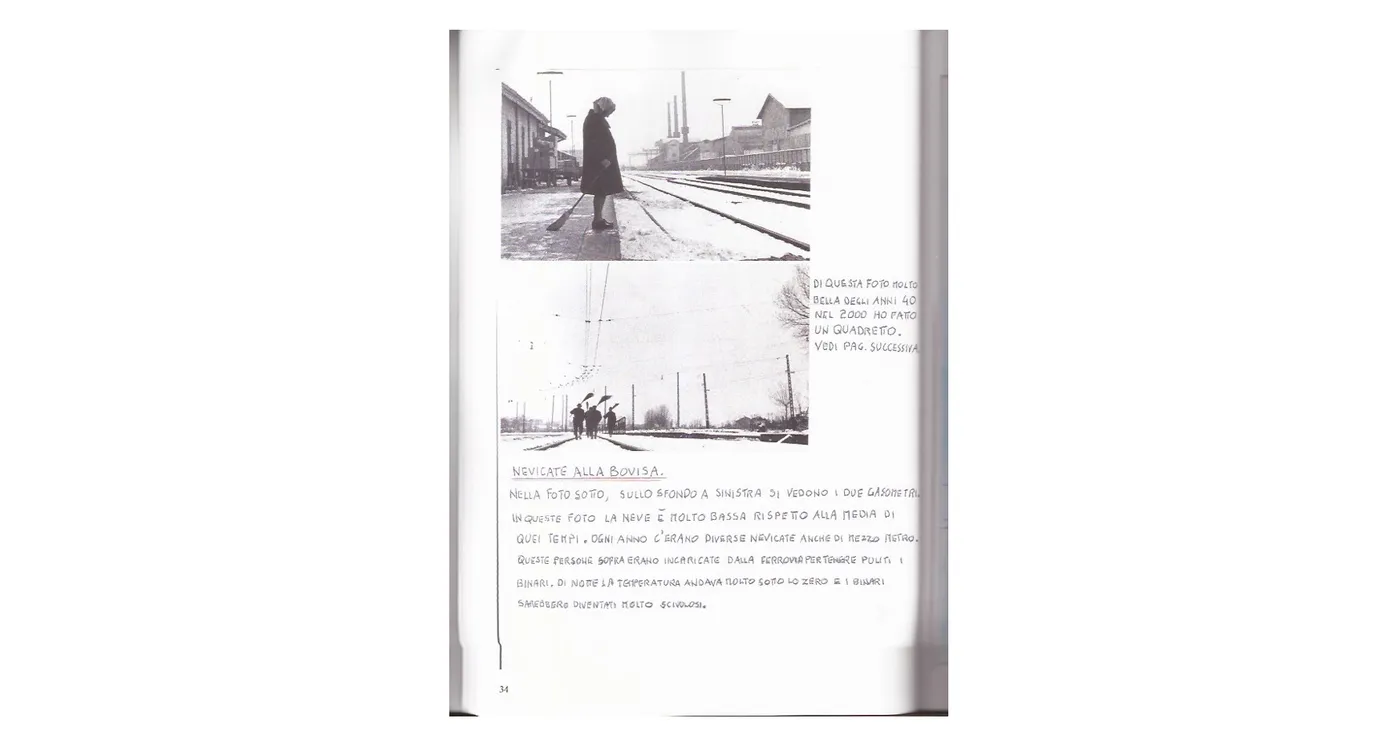
Snow in Bovisa. Two pictures from the book of Giovanni Parolini
AM I A COWARD?
Behind me, a cler chair is noisily pulled back.
Ovosodo is opening: a venue serving Tuscan food.
I stand up as well.
The chair I was sitting on must belong to the place.
I pretend nothing is happening, rummage in my pocket for the car keys, and walk back towards my car.
In NonnoNino’s memories, where Ovosodo now stands there used to be a tobacconist’s. Behind the tobacconist’s ran a canal, the Rigusela, flowing between factories. Further back there were — and still are — the railway tracks. Further back still, in the memories of Giovanni Parolini, known as NonnoNino, there is an end-of-year school recital: he was in his third year of lower secondary school.
“My music teacher, who adored me, had put my name down to perform on the accordion — among other things, a melody with no particular musical difficulty. But the thought of playing in front of an audience of around a hundred people, and of getting the notes wrong…” — here there are five heavily marked ellipses. “I found the solution. The day before the recital I went to the school office and said I couldn’t play because I had injured my right hand, showing a fake bandage. Am I a coward? A scaredy-cat? But I don’t consider myself one, having managed in my life to overcome so many troubles and obstacles, rather” — another five dots, less emphatic — “fragile, when it comes to things I feel I might not be able to do well.”
THE THINGS HE MANAGED TO DO WELL
After lower secondary school, Giovanni attended evening classes — during the day he took on small jobs to bring some money home — and obtained a diploma from a technical institute. He lived in the Mungüss until he married Silvana: it was 1 June 1963. Together they moved to Brusuglio, a hamlet of Cormano, where they still live today. Just outside their home stands a sign reading MILANO, marking the beginning of the city. He always worked as a technical draughtsman, mainly dealing with conveyor belts. He had two children, Claudio and Sonia. He now has four grandchildren.
POST SCRIPTUM
There are many drawings and many photographs in NonnoNino’s manuscript. Only one does not depict Milan. It shows a forest of trees with slender, soaring trunks; their crowns crowd the upper edge, while a bright light burns into the background, saturating the green in a dreamlike blend. A human figure, cropped just above the waist, in the lower left corner, holds an accordion. The caption was written by Giovanni himself.
“This wonderful photograph portrays a technician from a company that manufactures accordions in the Porto Recanati area. In an environment like this, he is able to evaluate the sound of the instrument perfectly, without any interfering noise. It would be wonderful for me to be able to do the same — not to test the sound of the instrument, but to play at random, without any fear of musical mistakes, knowing that my only listeners would be birds and squirrels.”
Nicola Feninno. Nicola Feninno (1987) è scrittore e direttore di CTRL magazine (rivista e casa editrice di reportage narrativo). È docente del corso “Scrittura dal vero” per la Scuola Holden di Torino e in quello di Art Direction per NABA (Nuova Accademia di Belle Arti di Milano). Come editor free-lance ha collaborato con Feltrinelli, Rizzoli, Salani e altre case editrici. È senior editor di Crudo Studio Editoriale. Nel 2022, nella collana l’invisibile di Industria & Letteratura, ha pubblicato il romanzo breve “Una storia vera”.